.webp)
There’s a moment in every sales organization when you realize the pipeline isn’t telling you the truth.
The numbers look fine. The board is full. The stages sound familiar… but something feels off. Deals aren’t moving the way the pipeline suggests. Forecasts drift. Reps interpret stages differently. Revenue feels unpredictable – not because the market changed, but because the system was never built to reflect reality in the first place.
A pipeline is supposed to show you the health of the business, but if it is not well designed, it hides the truth.
This is the point where leaders start tightening their process, demanding consistency, asking for clearer reporting, and questioning why a deal marked at 60 percent suddenly disappears. The issue isn’t the team. It’s the pipeline. And when you build it properly from scratch – with stages grounded in actions, not feelings – you get the visibility, accountability and predictability that a revenue engine depends on.
This Quick Win shows you how to build that pipeline.
What a Properly Built Deal Pipeline Delivers
A clean, easy-to-use pipeline that your sales team will actually adopt. Clear stages, accurate probabilities, consistent definitions and reporting you can trust. No more guesswork, no more “interpretation”, and no more spreadsheets sitting outside the CRM because no one trusts the data.
Why Deal Pipeline Quality Drives Revenue Predictability
Most pipelines fall apart for one simple reason: the stages don’t mean anything. If a stage doesn’t reflect a real commitment or a real action, it can’t produce reliable data. And unreliable data creates unreliable forecasts.
A proper pipeline removes ambiguity. It forces clarity. It standardizes how deals progress so leadership sees what’s real – not what reps hope will happen. When your pipeline reflects behavior instead of emotion, forecasting becomes more accurate, handovers become cleaner and revenue risk becomes visible.
Who Needs to Pay Attention
- Sales leaders responsible for forecasting accuracy
- SDRs and AEs who want a pipeline that matches reality
- Ops teams running reporting, dashboards and attribution
- Founders managing early-stage revenue themselves
- Teams migrating from spreadsheets or legacy CRMs
How to Build a Deal Pipeline That Actually Works in HubSpot
This approach works across all HubSpot tiers, from Free to Enterprise.
1. Create a new pipeline
Settings → Objects → Deals → Pipelines → Create Pipeline
Keep the name simple and obvious - avoid internal jargon.
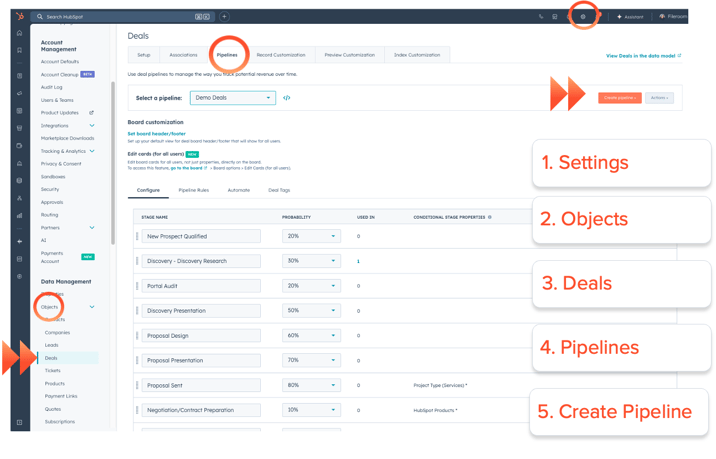
2. Define action-based stages
Stages must reflect actions, not vibes or optimism.
- New prospect qualified
- Discovery completed
- Proposal requested
- Proposal sent
- Negotiation
- Closed won
- Closed lost
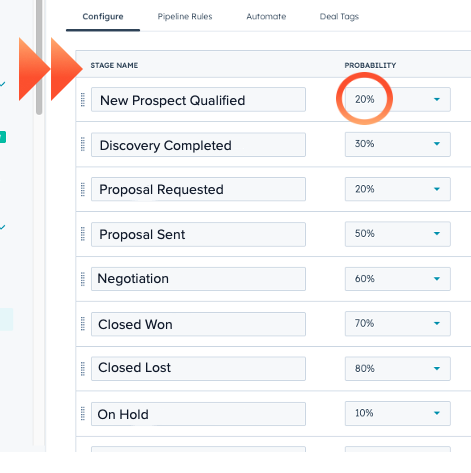
3. Assign realistic close probabilities
Not based on hope – based on behavior.
- Discovery completed = 20%
- Proposal sent = 50%
- Negotiation = 60%
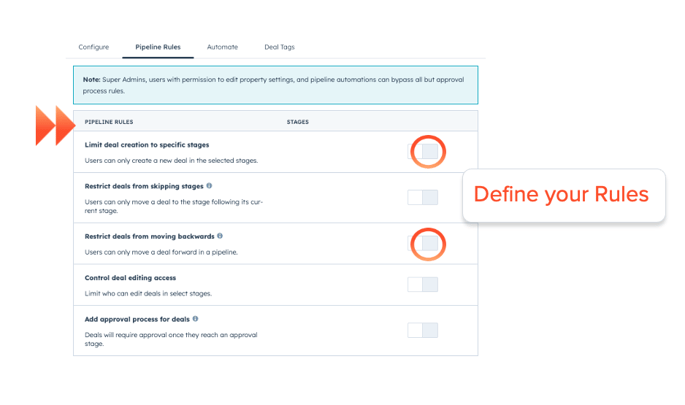
4. Set entry and exit criteria for every stage
This is what creates consistency.
Example: You cannot move a deal to “Proposal Sent” unless the actual document is attached.
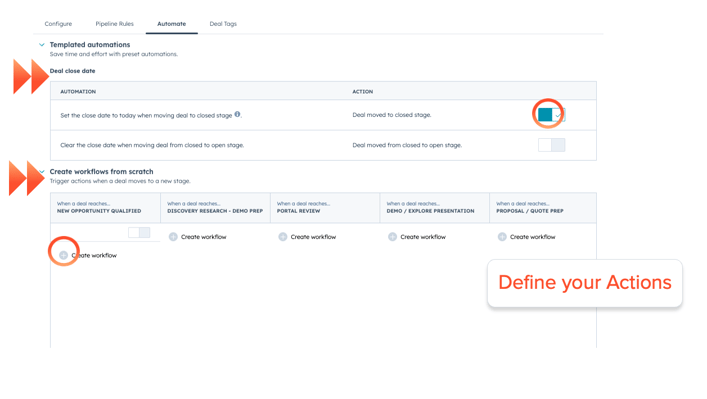
5. Add automation to enforce consistency
Create tasks when deals enter key stages.
- Alert reps when deals stagnate
- Auto-assign owners for inbound deals
6. Test it with the team before launch
Ask three critical questions:
- “Does each stage mean the same thing for everyone?”
- “Where do deals normally get stuck?”
- “What do we need to remove?”
A pipeline only works when the team agrees on how to use it.
The Revenue Problem This Pipeline Fixes
Bad pipelines create blind spots.
Reps move deals based on optimism, leaders forecast based on fiction and teams argue about what "in progress" even means. By building a pipeline with clear actions and real criteria, you replace ambiguity with accountability - and your forecasts start behaving like forecasts, not wish lists.
Important Limitations to Understand
- Pipelines require maintenance as your sales process evolves
- Entry/exit criteria must be enforced or the system deteriorates
- Too many stages create friction and hurt adoption
- Multiple pipelines create confusion unless each has a clear purpose
- Incorrect close dates destroy forecasting accuracy – train reps from day one
Need Expert Support?
We can rebuild your pipeline, fix your forecasting and restructure your CRM so your sales team finally has a system they trust – and leaders have numbers they can rely on.
Schedule A Call



.png)




-1.png?width=19&height=19&name=Vector%20(3)-1.png)

.png?width=19&height=16&name=Vector%20(4).png)

.png?width=18&height=24&name=Vector%20(5).png)