
If the real problem in your CRM is data mess, you're in the right place to solve it. This Quick Win shows you how to turn AI into the guardian of your CRM.
As your organization grows, more people enter data, more systems connect, more records sync, and more “quick fixes” creep in. Suddenly your CRM isn’t a source of truth anymore – it’s a source of friction. Reports stop matching reality, dashboards drift, automations misfire, and leadership begins questioning whether the numbers can be trusted.
Bad data doesn’t announce itself. It spreads quietly and slowly, until the cost shows up in missed insights, failed handovers and flawed decision-making.
This is exactly where AI gives teams a capability they’ve never had before: real-time, system-wide data standardization. Instead of cleaning data months after the damage is done, AI prevents the mess from forming in the first place.
What AI-Powered Data Cleaning Delivers
A continuously improving CRM that standardizes data as it’s created. AI fixes casing, formatting, duplicate patterns and human entry errors automatically, which means your lists, workflows, reports and dashboards behave the way they’re supposed to – even as your team and systems scale.
Why AI-Driven Data Quality Matters for Revenue Operations
Poor data is the silent cause of broken automation, inaccurate reporting, failed segmentation and operational chaos.
- If your lifecycle stages are inconsistent, your funnel collapses.
- If your lead sources are unreliable, attribution becomes meaningless.
- If contact data is messy, your sales team loses trust in the CRM.
Who Benefits From AI Data Cleaning
- RevOps and Operations teams managing CRM governance
- Marketing teams building segmentation and attribution models
- Sales teams depending on accurate contact and deal data
- Customer Service teams managing SLAs and ticket routing
- Any organization scaling HubSpot or preparing for automation-heavy processes
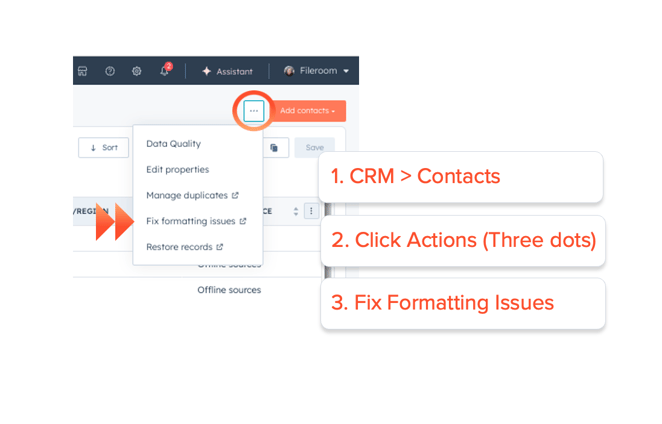
That's where HubSpot stands out as a powerful solution. Its AI can automatically correct formatting, catch inconsistencies, fix common errors and enforce field standards in the background, reducing the need for manual clean-up projects or constant data policing. The strongest performance is available on HubSpot Pro and Enterprise, though organizations across all tiers benefit from improved data quality.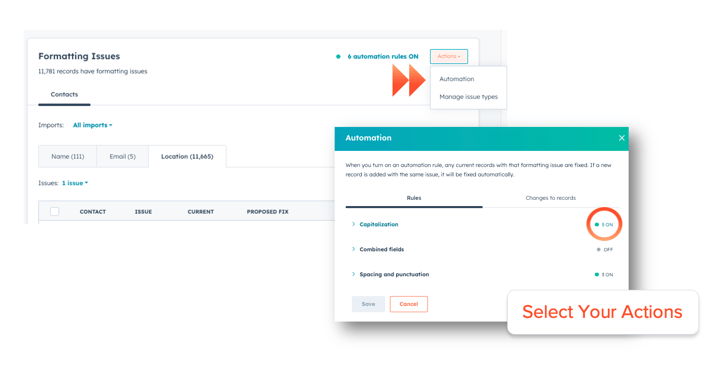
How to Implement AI-Driven Data Quality in HubSpot
1. Turn on Smart CRM Formatting Rules
HubSpot automatically cleans casing, removes whitespace and standardizes common text fields.
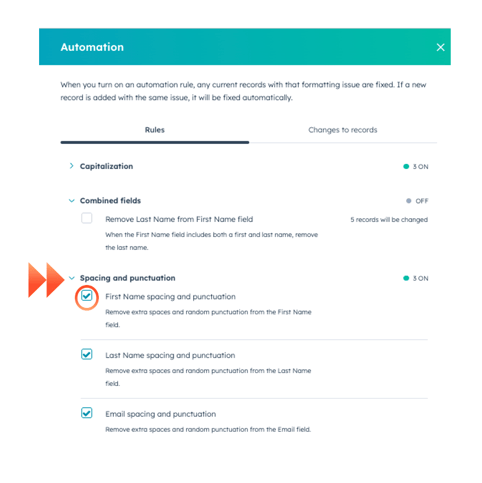
2. Enable AI property validation rules
Use them to enforce structure:
- numeric-only fields
- required naming formats
- taxonomy standards
- prohibited characters
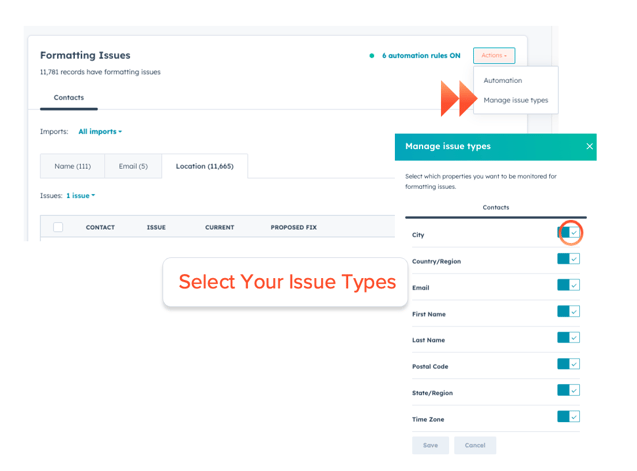
3. Use the AI Assistant to fix inconsistent records
Ask it to clean:
- contact names
- company names
- job titles
- regional data
- duplicate patterns
You can also create workflows that enforce your data standards, generate AI cleanup summaries
or lock down sensitive fields to keep control of your data.
The Operational Problems AI Data Cleaning Eliminates
- Manual data cleanup – slow, reactive and impossible to scale
- Inconsistent data entry across teams
- Automation failures triggered by inaccurate or incomplete records
- Ongoing reliance on individuals to use the system correctly
Important Limitations to Consider
- AI cannot create business logic you haven’t defined.
- Poor naming conventions will remain poor until you fix the root taxonomy.
- Duplicate detection improves with volume; small portals see less accuracy.
- Sensitive fields (budget, revenue) still require human oversight.
- You must clearly define the “source of truth” for synced systems – AI won’t choose for you.
Need Expert Support?
We can audit your CRM structure, define your data standards and build AI-driven rules that keep your CRM clean and reliable so your automations and reporting stop breaking when new data enters the system.
Schedule A Call



.png)




-1.png?width=19&height=19&name=Vector%20(3)-1.png)

.png?width=19&height=16&name=Vector%20(4).png)

.png?width=18&height=24&name=Vector%20(5).png)