B2B marketing built on traditional approaches is no longer effective for complex and industrial organizations. In many cases, it has become a constraint rather than a growth driver.
Privacy regulations limit visibility. Buyers are time-poor and overexposed to information. Buying committees are larger, more technical, and more risk-averse. Decision-making cycles extend across months or years, shaped by compliance, specifications, procurement, and internal approvals.
This reality requires business leaders to reassess approaches that were widely accepted as best practice only a few years ago.
When we refer to “traditional marketing” today, we are not talking about radio, print, or trade magazines. We are referring to relatively recent approaches such as programmatic advertising, generic paid media funnels, keyword-driven SEO without intent depth, surface-level personalization, and volume-based lead generation models that are now showing diminishing returns.
The B2B Buyer and the New Gatekeepers
You know how difficult it is to connect with a B2B buyer. They are no longer consuming branded content directly from traditional media. Who is still reading newspapers? Chances are high they get most of their industry news through social media and professional networks. On top of that, information is filtered by privacy controls, enterprise security tools, internal policies, and increasingly by AI-driven systems.
Marketing now interacts not only with human decision-makers, but also with AI-assisted buyers and automated filters that determine what reaches screens, inboxes, and shortlists.
As a result, relevance matters more than reach. Context matters more than volume. Trust and clarity matter more than frequency. Marketing strategies optimized purely for platforms, algorithms, or Ads delivery fail to reflect how decisions are actually made inside B2B organizations.
Why Traditional Agency Models Struggle
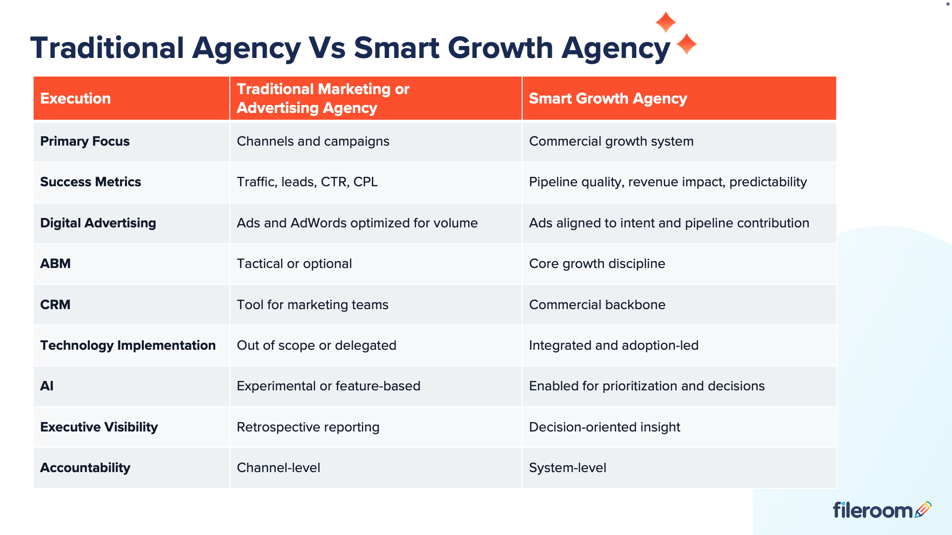
Most traditional marketing agencies and digital advertising agencies remain structured around execution rather than integration.
We have been there. Channels are optimized independently. Ads and AdWords are measured on efficiency and volume. Technology is treated as a toolset rather than commercial infrastructure. Downstream impact on pipeline and revenue often sits outside scope.
This is particularly common in B2B organizations working with multiple marketing agencies, advertising agencies, and technology vendors, each optimizing a narrow part of the growth equation.
For business leaders, this points to familiar challenges:
- Increased activity without improved pipeline quality
- Digital advertising spend that is harder to justify
- CRM platforms that exist but do not drive insight
- Alignment between teams that relies on individuals rather than systems
Smart Growth as the Next-Generation Model
Smart Growth is a response to this structural complexity. It brings together growth marketing, digital advertising, ABM, CRM platforms such as HubSpot and AI enablement, alongside traditional digital campaign elements such as Google Ads, social media, content execution, and technology implementation. It combines strategy, content, media, and technology into a single operating model designed around commercial outcomes.
In a Smart Growth model:
- Growth marketing aligns with revenue objectives
- Digital advertising is evaluated on intent and pipeline impact
- ABM focuses effort on high-value, high-fit accounts
- HubSpot operates as the commercial backbone, not just a database
- Data supports forecasting, prioritization, and accountability
- Technology implementation is driven by adoption, not features
- AI enablement supports decision-making rather than adding noise
The Role of a HubSpot Agency in a Smart Growth Model
In a Smart Growth model, the value of a HubSpot agency lies in how the platform is governed and operationalized, not in basic implementation.
HubSpot becomes the system where commercial processes are standardized: lifecycle stages are enforced, attribution is defined, data quality is protected, and automation reduces manual effort across teams. The agency’s role is to ensure HubSpot reflects how the business actually sells and operates, rather than how the software is configured by default.
When done well, HubSpot provides leadership with reliable visibility across marketing, sales, and customer activity, enabling alignment and execution at scale.
Smart Growth Is an Adaptation, Not a Trend
The industry continues to increase in complexity. Buyers are more informed, more protected, and more selective. Technology increasingly shapes how information flows and how decisions are made.
Smart Growth reflects this shift. It responds to how buying decisions actually happen today, not how marketing teams wish they did.
Sustainable growth now depends on alignment between strategy, systems, data, and execution, rather than isolated tactics or short-term optimization. For organizations planning their next phase of growth, understanding this distinction is no longer optional. It is a leadership responsibility.
Need Expert Support?
If you want to move beyond fragmented marketing and build a scalable Smart Growth model, we can review your current setup across marketing, advertising, CRM, and technology to identify gaps, risks, and opportunities for alignment.
We focus on making growth measurable, compliant, and operationally sustainable, so your systems support better decisions, not more complexity.
Schedule A Call



.png)




-1.png?width=19&height=19&name=Vector%20(3)-1.png)

.png?width=19&height=16&name=Vector%20(4).png)

.png?width=18&height=24&name=Vector%20(5).png)