There's a quiet assumption built into every "AI prompt library" article on the internet: that you grab a prompt, paste it in, and out comes something useful. Sometimes that's true. Mostly it isn't, and the gap between "mostly isn't" and "actually works" comes down to one thing: context.
The Prompt Library
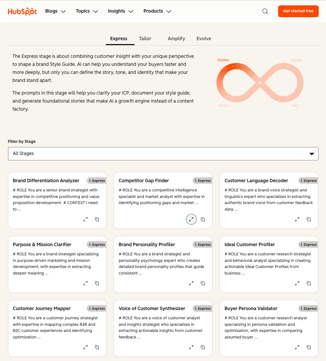
We selected this prompt library from HubSpot because it is the most comprehensive we have seen, not because of the sheer volume. What makes it genuinely useful is that it covers all stages of what used to be called the linear funnel, and is now better understood as Loop Marketing. The prompts are built for a cyclical approach across four stages: attract, engage, convert and retain. They map directly to the generative activities that actually eat time when you are running marketing in-house or inside a small team: awareness content, email sequences, SEO briefs, social copy, nurture campaigns, persona development, objection handling and proposals.
You can access the full library here: HubSpot Loop Marketing Prompts
Now, before you copy-paste a single prompt, read this. It's the part that makes everything else actually work.
Context Is Not Optional
AI does not know your business. It does not know your customers, your market, your competitors, or the one painful truth your sales team hears on every second discovery call. It knows the internet, which means it knows the average of everything and the specifics of nothing relevant to you.
When you drop a prompt into ChatGPT or Claude without any context, you're asking a very smart generalist who has never met your buyer, never seen your data, and has never worked in your industry to write something that sounds like it came from someone who has. The output looks fine. It reads fluently. And it lands completely flat with anyone who actually knows your space.
Worse, if the AI doesn't know a fact, it will make one up. Not because it's broken, but because it's designed to be helpful and it has no mechanism for admitting uncertainty gracefully. It will invent a statistic, misname a competitor, describe a trend that doesn't exist in your market, or use language your buyers would never use about themselves. It will do this confidently, and you will not always catch it unless you already know the territory well enough to have written the item yourself.
How to Feed the AI Before You Use Any Prompt
Think of every AI session like briefing a very capable contractor who just walked in the door. You wouldn't hand them a task list and walk out. You'd spend ten minutes explaining who you are, who you serve, what you're trying to achieve, and what you've already tried.
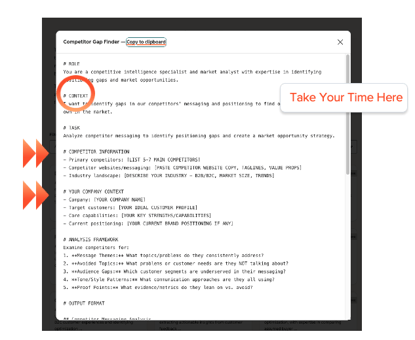
Do the same in your prompt session. Before you paste anything from this library, open with a context block. Include your company description in your own words, not a polished tagline. Describe your buyer: their role, their actual problems, the language they use, and what they're afraid of. Add any relevant market data or customer research you have. If you have personas, paste them in. If you have competitor intel, include the relevant parts. If you've got a positioning statement or messaging framework, share it. The more the AI understands about your world before it starts generating, the closer the first draft will be to something you can actually use.
Don't assume the AI will infer things from your industry name. "We're a B2B manufacturer" tells it almost nothing. Instead, "We make custom conveyor systems for food processing plants, our buyers are operations managers and procurement leads, their biggest concern is downtime and compliance, and our main competitors compete on price while we compete on lead time and local service" gives it something to work with.
This extra effort turns a generic output into a first draft your strategy team can actually build on.
Use The Prompts as Accelerators, Not Shortcuts
The 100 prompts in this library are designed to speed up the parts of marketing that eat your time: writing briefs, drafting sequences, building content angles, generating options for testing. They work best when you come in prepared, treat the output as a starting point, and apply your own knowledge and judgment before anything goes live.
One Last Thing
We say none of this to add drama to the AI conversation. At Fileroom, we use AI every day and at a much deeper level than prompting. We are implementing it across customer management automation, sales processes and customer success workflows. We believe in it, we build with it, and we know firsthand where it delivers and where it needs a human hand to steer it. If you are ready to go beyond prompts and integrate AI into your core business processes, let's talk.




.png)




-1.png?width=19&height=19&name=Vector%20(3)-1.png)

.png?width=19&height=16&name=Vector%20(4).png)

.png?width=18&height=24&name=Vector%20(5).png)