There's a problem we've seen repeat itself across industrial and construction businesses for years, and nobody talks about it plainly enough: the humble phone call is still the most important moment in the sales and service process, and yet it's also the least supported.
When a prospect calls, your team has once chance to get it right. Miss it, and the opportunity is lost. In a real-time moment like that, anything can happen. The salesperson might take great notes – or none at all. They might ask the right qualifying questions – or forget entirely. They might follow up with context – or send a generic email two days later.
The quality of that conversation, and everything that flows from it, has always depended on the individual holding the phone. No guardrails. No structure. No visibility. Just one person trying to get it right under pressure, every single time.
But this isn’t a people problem. It’s a systems problem.
People will always respond differently in the moment. That’s human. What’s changed is our ability to support them – by putting the right structure, guidance, and visibility around every interaction.
The Message Gets Lost in Translation
Here’s the frustration we hear most from clients in trades, construction, and industrial services: the customer’s message gets diluted before it reaches anyone who can act on it.
And it’s not because the team isn’t trying. It’s because operations move fast and the conversations are highly technical.
When a procurement manager calls to specify an industrial component, or a site supervisor needs to scope a service, there are layers of detail that require real expertise to capture correctly. But your specialist isn’t on every call – they can’t be. So the person who answers does their best. They take notes in plain language and pass it on.
By the time it reaches someone who can properly assess the requirement, something has shifted. A spec gets approximated. A constraint gets dropped. The urgency in the caller’s voice doesn’t survive the handoff.
That’s not a failure of effort. It’s the natural limit of asking one person to be both a clear communicator and a technical translator, on every call, without support.
What AI Assist Pro Actually Changes
Aircall’s AI Assist Pro is built on a simple shift: don’t wait until after the call to analyse what went wrong – equip reps while the conversation is still happening.
In practice, that looks like real-time coaching aligned to your team’s playbook, whether that’s BANT, SPICED, or your own qualification framework. Prompts surface when a rep drifts off track or misses a key question, helping them course-correct in the moment.
At the same time, the admin layer disappears. The CRM updates automatically, follow-up tasks are created, and every call is consistently scored – without relying on manual input.
What’s most valuable here, from a technology enablement standpoint, is that it removes the ceiling on consistency. That’s where the real impact shows up.
When everyone operates from the same structure, knowledge stops living in individual heads and starts functioning as a shared standard. A rep who’s been with you for six months can run the same quality of conversation as someone with a decade of experience. Institutional knowledge becomes infrastructure.
And in sectors where projects are complex and relationships take time to build, that consistency is what turns a strong first call into a pipeline that actually moves.
The AI Voice Agent: Solving the Problem Nobody Wants to Admit
Let's talk about the calls that shouldn't require a human at all.
The reality in B2B, construction and industrial services is that call volume doesn't follow business hours, and the team's capacity has a ceiling. Quotes get requested at 6pm. A returning client calls mid-morning when everyone is already tied up. A supplier needs to confirm a detail during your busiest window.
None of those calls are unimportant, in fact, most are exactly the touchpoints that keep relationships alive. But when the team is stretched, something gives – and it's usually the call that came in at the wrong moment.
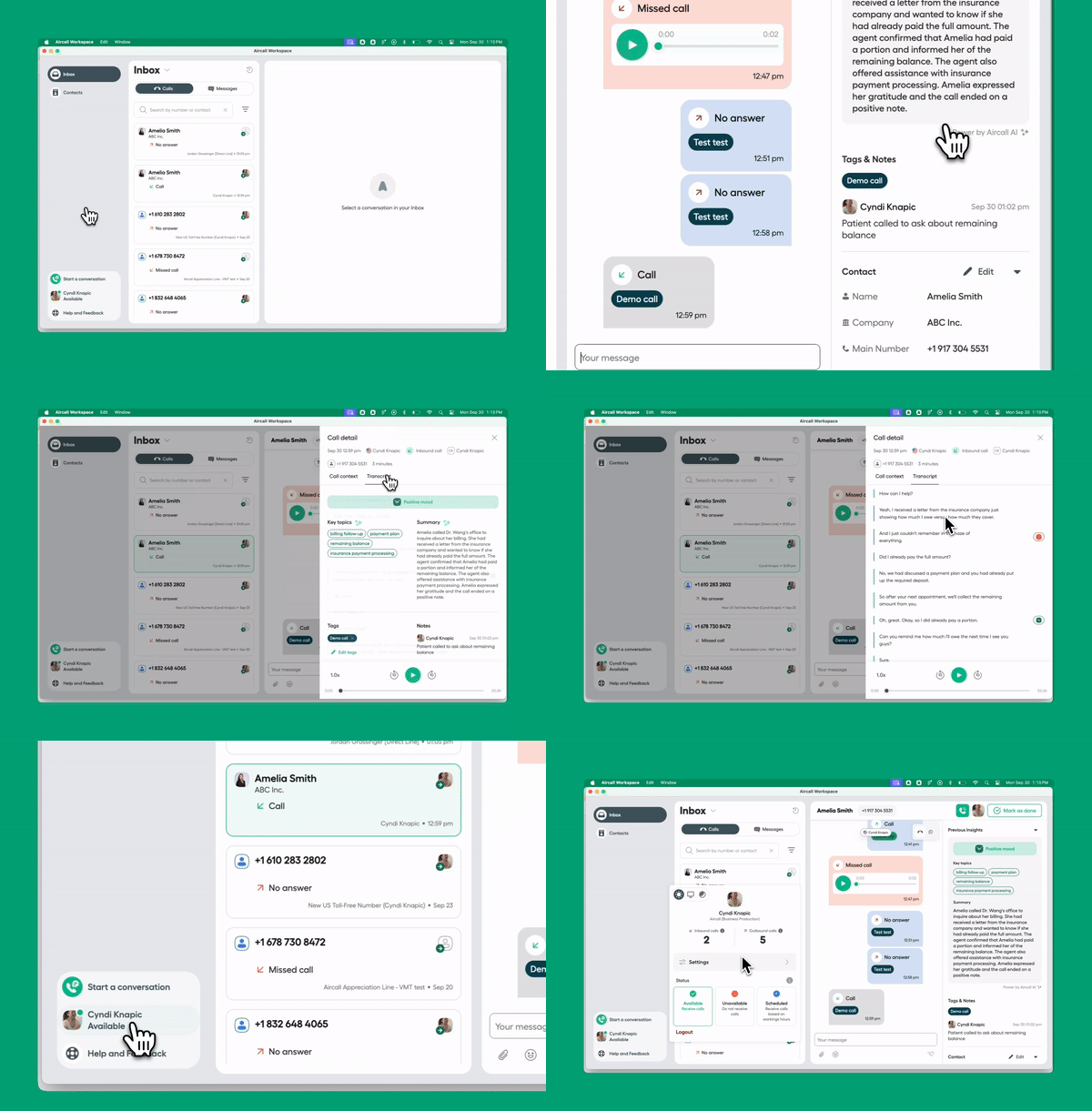
The AI Voice Agent handles that layer. Routine enquiries, after-hours lead capture, first-pass qualification, appointment scheduling – it runs continuously without adding headcount. And critically, when something does require a human, it routes and escalates with full context already captured.
The real value isn't just efficiency. It's that you stop losing prospects to timing.
That's revenue that was previously invisible.
Where This Connects to Actual Revenue Visibility
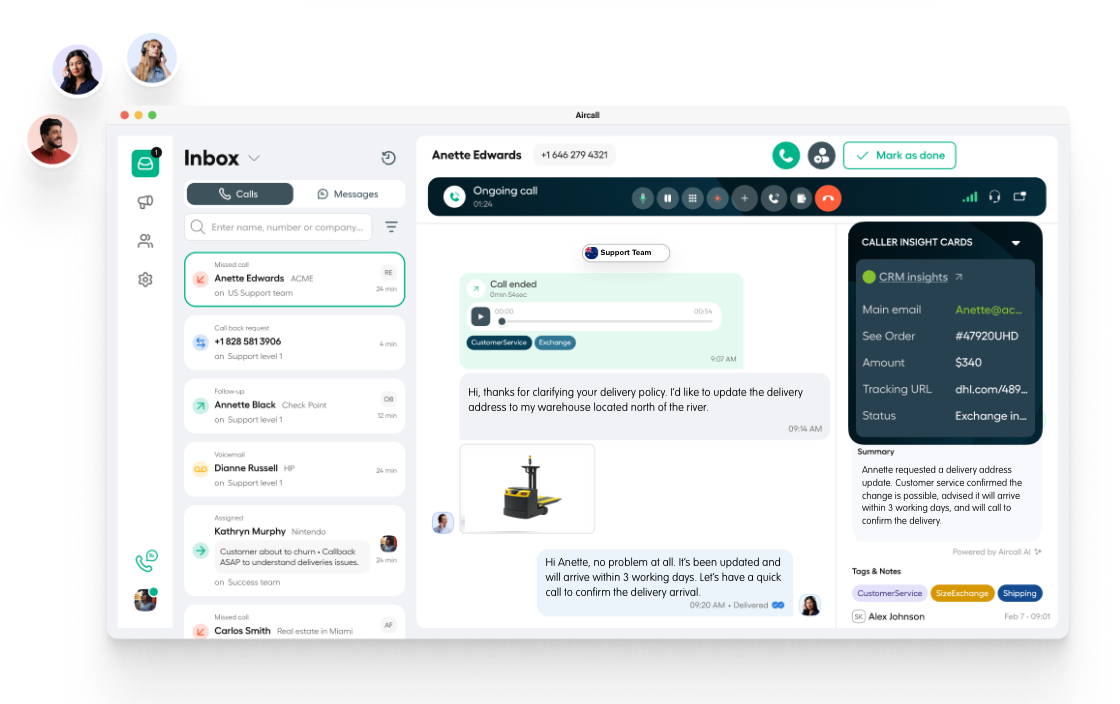
When AI is properly integrated with your CRM and operations stack, every call stops being an isolated event and becomes part of a connected revenue picture.
The conversation is recorded and categorized. Topics are tagged. Follow-ups are triggered automatically, with real context, not a generic template. The right notification reaches the right person at the right time. What used to take a rep 20 minutes of post-call admin – if it got done at all – now happens instantly and consistently in the background.
Connect that to HubSpot for pipeline management and a field operations platform like Simpro, and you've effectively closed a loop most businesses in this sector don't even realise is open. You can now see which conversations lead to quotes. Which quotes convert. Which job types close at the highest rate. Where prospects drop out of the process. Attribution that was once murky becomes clear.
That's not just better data visibility – it's better decision making. Knowing where to focus, who to prioritise, and what’s actually driving revenue.
Where to Start
Start by defining what a good call looks like in your business. Not in general terms, be specific.
-
What questions need to be asked?
-
What information must be captured?
-
What does a qualified lead look like versus a tire-kicker?
That definition becomes your playbook. And the playbook is what the AI runs on.
From there, pick one revenue-critical workflow and implement AI Assist Pro first. Inbound sales calls are usually the best starting point. Get it running, connect it to your CRM, and review what the data is actually telling you.
Next, layer in the AI Voice Agent for the repetitive, high-volume work – after-hours calls, FAQs, and initial qualification – once the human-assisted layer is stable.
Then connect everything back into your operations stack. Because the real opportunity isn’t just better calls. It’s the ability to draw a straight line from a conversation to a closed job. That visibility changes how the business runs.
If you need expert help deciding which agent to start with and how to integrate it into your stack without overcomplicating it, we can help you map that out. Contact us.




.png)




-1.png?width=19&height=19&name=Vector%20(3)-1.png)

.png?width=19&height=16&name=Vector%20(4).png)

.png?width=18&height=24&name=Vector%20(5).png)