Most organizations want automation, but they delay it.
Not because they lack the tools, but because teams assume automation requires technical expertise, specialist roles, or a full RevOps function. As a result, they keep relying on manual handovers, ad-hoc follow-ups, and spreadsheets held together by optimism.
Meanwhile, the business absorbs the cost: slow response times, inconsistent customer experience, missed opportunities, and reporting you simply cannot trust.
The Real Problem Isn't Complexity
Most automations your organization needs are not complicated. They are not “systems projects”. They are small, high-impact processes that remove friction and enforce consistency across sales, service and marketing.
HubSpot’s current workflow builder makes this accessible for non-technical teams. It validates logic, tests scenarios before activation, and makes it almost impossible to “break the system”. In other words, leaders no longer need technical specialists to operationalize the basics.
The moment you automate even one recurring process, behavior changes.
-
A rep no longer “forgets” the follow-up.
-
A ticket no longer sits unnoticed for three days.
-
A high-value lead is no longer left waiting.
-
Everyone starts seeing the value of predictable, automated motion.
Executives feel this quickly because the impact shows up in pipeline visibility, response times, and customer satisfaction long before it appears in revenue.
If your team needs a starting point, here are the five must-have automations that deliver immediate value with minimal risk.
Five Must-Have Automations Every Business Should Implement
1. Instant Lead Assignment and Notification
When a lead submits a form:
-
Assign an owner
-
Notify them immediately
-
Create a follow-up task
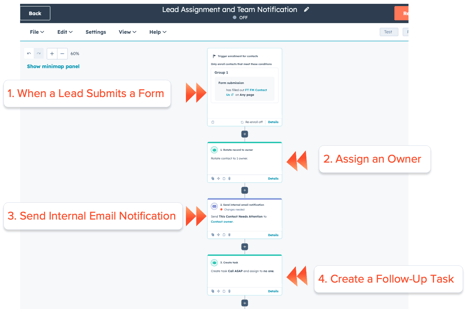
This single automation removes the biggest leak in most sales processes: slow response.
2. Deal Stagnation Alerts
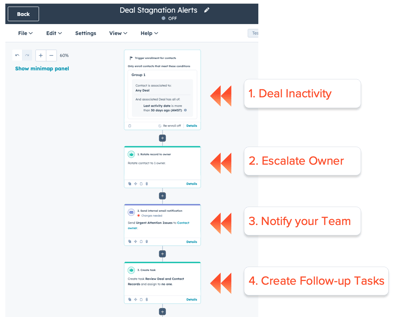
If a deal sits untouched for a set number of days, HubSpot alerts the owner and can escalate to a manager.
This is a simple way to prevent pipeline decay and eliminate “false forecast confidence”.
3. Ticket Escalation for Missed SLAs
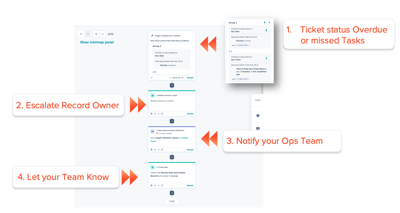
If a customer waits too long for a response, alert the team lead and create a priority task.
Executives concerned about retention should treat this as non-negotiable.
4. Lifecycle Stage Enforcement
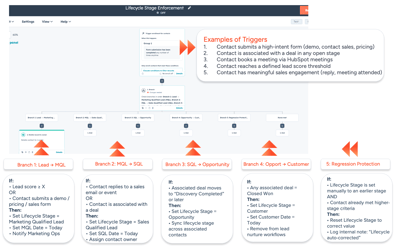
Automatically update lifecycle stage based on clear behavioral triggers.
This removes human inconsistency and gives leadership accurate funnel reporting.
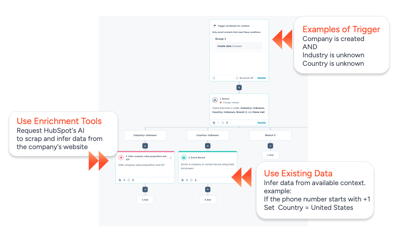
5. Auto-Cleanup of Critical Fields
If key data is missing (industry, region, deal amount, source), trigger a task or auto-fill where possible.
Reliable reporting starts with reliable data.
These automations do not replace people.
They remove the friction that prevents people from doing their jobs consistently and effectively.
For leaders like you, the value is straightforward:
-
More predictable revenue
-
Faster response times
-
Clean data
-
Better forecasting
-
A CRM the organization can trust
Once these basics are in place, automation stops feeling like a technical project and starts behaving like what it really is – an operational advantage.
Need Expert Support?
Schedule A Call



.png)




-1.png?width=19&height=19&name=Vector%20(3)-1.png)

.png?width=19&height=16&name=Vector%20(4).png)

.png?width=18&height=24&name=Vector%20(5).png)