If you have been paying attention to marketing conversations lately, you have probably noticed a wave of new acronyms landing alongside traditional SEO: AEO, GEO, LLMO, AIO, GXO. The terminology is unsettled, and that can make it harder than it should be to cut through the noise. This article does not add to the confusion. It focuses on the three frameworks that matter most for B2B marketers right now: SEO, AEO and GEO. We will explain what each one is, how they differ, and, more importantly, how they work together.
Why Search has Changed
Until recently, search optimization had one primary goal: rank as high as possible on Google, drive clicks to your site, and convert visitors. That model is under pressure from two directions.
First, zero click behavior has accelerated. Google now serves more answers directly in search through features such as AI Overviews, featured snippets and other answer formats, which means a growing share of searches end without a visit to an external site. Google itself now advises site owners to think about how content appears in AI powered search experiences, not just in classic blue link rankings.
Second, Google is no longer the only place people go to research. Buyers are increasingly using tools like ChatGPT, Gemini and Perplexity to explore categories, compare vendors and sense check options before they ever visit a company website. That behavior is changing what visibility means. It's no longer just about whether you rank. It's also whether your content gets surfaced, summarized and cited. This does not mean SEO is dead. It means visibility now happens across multiple surfaces, and optimizing for only one of them leaves opportunity, and revenue, on the table.
1. SEO: Still the Foundation
Search Engine Optimization remains the bedrock of digital visibility. Its core purpose has not changed: when a potential buyer types a query into Google or Bing, your content needs to appear and earn attention.
What has changed is the sophistication required. Modern SEO is built on several interlocking elements:
-
Technical health: page speed, crawlability, mobile performance, Core Web Vitals
-
Content quality: depth, accuracy, and clear alignment with search intent
-
Authority signals: backlinks, domain trust, and brand mentions across the web
-
E-E-A-T: demonstrating Experience, Expertise, Authoritativeness, and Trustworthiness
For B2B marketers, SEO remains especially important for high intent, bottom of funnel queries. These are the searches that suggest a buyer is actively evaluating solutions. Without a solid SEO foundation, the other two frameworks have less to build on. So, while newer approaches are earning attention, SEO still does the foundational work. Without that base, AEO and GEO become much harder to execute well.
2. AEO: Optimizing for Direct Answers
Answer Engine Optimization is the practice of structuring content so it can be surfaced as a direct answer in places like featured snippets, AI Overviews, voice search results and question led interfaces.
The shift AEO responds to is a change in how people search. Users increasingly ask complete questions rather than entering short keyword fragments. When they do, search engines look for content that can satisfy that question clearly and immediately.
Practically, AEO means rethinking how you structure content:
-
Lead with the answer: the first sentence of any section should directly address the question being asked
-
Use question-based headings: H2s and H3s that mirror how your audience phrases their queries
-
Add FAQ sections: structured, standalone Q&A blocks that are easy for search engines to extract
-
Implement schema markup: FAQ, HowTo, and Article schema help search engines identify and surface your answers
-
Keep answers concise: direct, specific answers of 40 to 60 words tend to perform well for featured snippets
For B2B marketers, AEO is especially useful higher up the funnel, where buyers are researching categories, comparing approaches and looking for clarity before they are ready to enquire.
If your content buries the answer three paragraphs down, AEO is unlikely to work well for you. Each section needs to open with the point, not the preamble.
3. GEO: Getting Cited by AI
Generative Engine Optimization is the newest of the three disciplines, and also the most misunderstood. Its goal is to make your brand and content citation worthy inside AI generated responses, the kind that appear when someone asks a tool like ChatGPT or Perplexity a question such as, “What is the best approach to B2B demand generation?”
Traditional search returns a ranked list of links. Generative AI does something different. It synthesizes information from multiple sources into a single response. Getting cited means your content, or your brand, was considered relevant and trustworthy enough to be included in that answer.
What makes content citation worthy? Research points to several consistent factors:
-
Original data and research: AI engines preferentially cite content that provides unique information not readily available elsewhere
-
Topical authority: covering a subject comprehensively across multiple pieces of content signals genuine expertise
-
Structured, extractable content: clear headings, concise definitions, and logical organization make it easier for AI to parse and cite your work
-
Third-party platform presence: AI engines frequently cite Reddit, YouTube, LinkedIn, and industry forums, meaning your visibility on these platforms contributes to GEO
-
Brand consistency: using the same terminology, positioning, and entity names across all content helps AI systems recognize and consistently reference your brand
There is an important nuance here. Being cited by AI does not always translate into strong referral traffic. Current publisher data suggests AI chatbot referrals are still a very small share of overall pageview traffic, even when they are growing quickly. For B2B marketers, GEO is better understood, at least for now, as a visibility and authority play rather than a pure traffic channel. That matters because not every valuable impression ends in a click. If your brand is repeatedly associated with credible answers in your category, that recognition compounds over time, even when the visit happens later or somewhere else in the journey.
How SEO, AEO and GEO Work Together
The most common mistake is to treat these three as competing priorities. They are not. They address different surfaces in the same buyer journey, and they share far more overlap than the acronyms suggest.
SEO is still the engine behind discoverability in classic search results. AEO improves your chances of appearing in direct answer environments such as featured snippets and AI generated summaries. GEO strengthens your chances of being cited or referenced inside generative platforms such as ChatGPT, Claude, Gemini and Perplexity. The table below summarizes how SEO, AEO, and GEO work together.
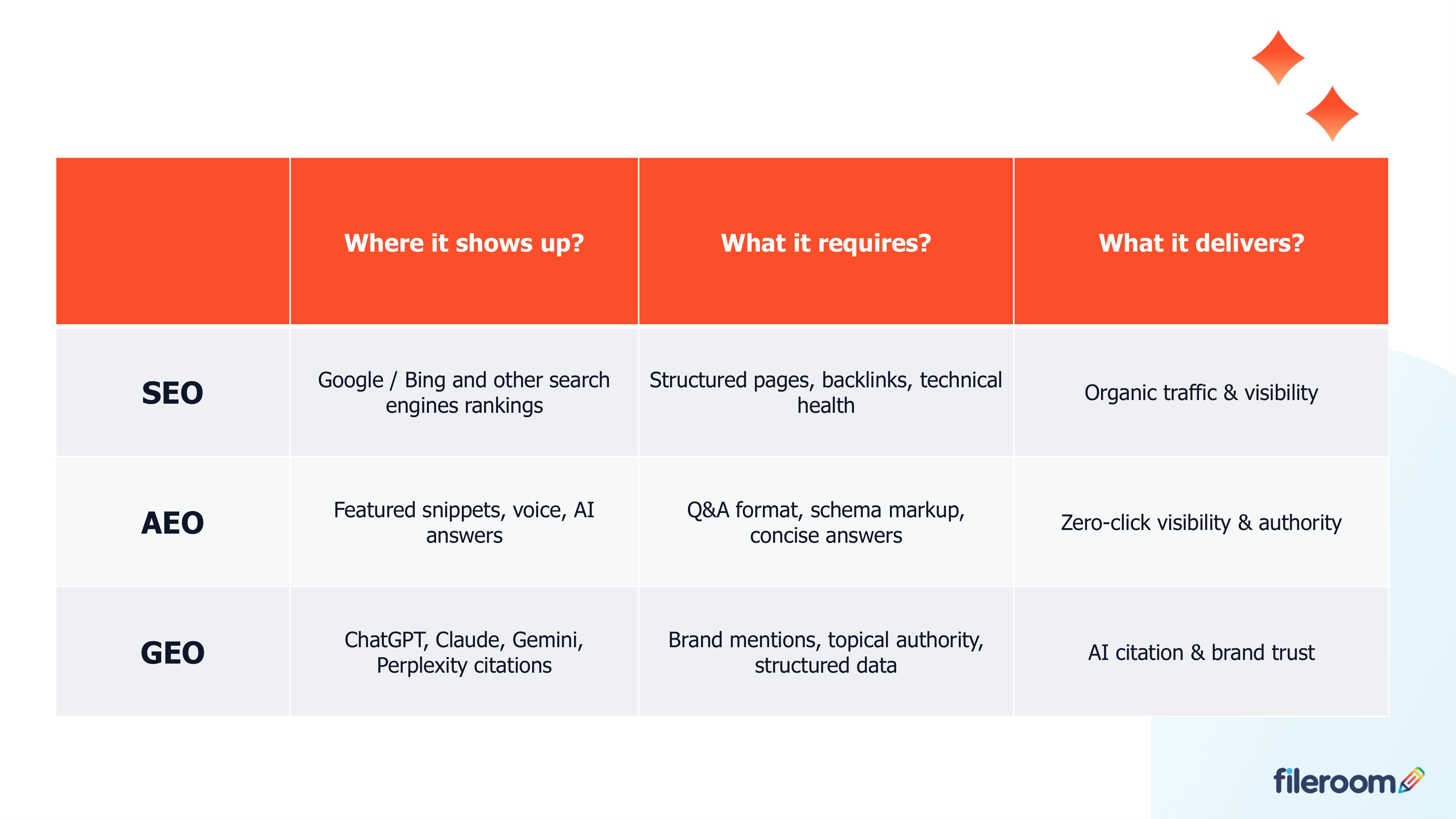
In practice, the tactics that strengthen one often reinforce the others. Structured content improves AEO performance and also makes your pages easier for AI systems to extract and cite. Strong trust signals support SEO rankings and make your brand more credible in generative environments. A well built FAQ section can serve featured snippets while also giving AI systems clean, standalone answers to pull from.
The key is integration. Brands that are doing this well are not running three separate programs. They are building content and technical foundations that can do all three jobs at once.
Where to Start
If you want to pressure test your current approach, start with the fundamentals.
-
For SEO, that means a serious look at technical health, crawlability, speed, mobile experience, and content quality. It also means checking whether your authority signals and trust markers are strong enough to support the topics you want to win.
-
For AEO, review how your pages are written. Are you leading with direct answers, or still making readers work too hard to find them? Are your headings aligned with the way buyers actually phrase their questions? Are your service and resource pages structured in a way that makes extraction easy?
-
For GEO, look beyond your website. Are you publishing genuinely original thinking, data, or frameworks, or just repackaging what everyone else is already saying? Is your brand terminology consistent across your site, LinkedIn, YouTube, and the other platforms where your expertise shows up? Are you visible in the places AI systems are likely to encounter and reference?
None of this requires abandoning what already works. It requires tightening it. The brands that benefit most from GEO are usually not doing something magical. They are doing the basics properly, with more consistency and more substance than their competitors.
At Fileroom, this is exactly where we help B2B teams close the gap between theory and execution. Our SEO and content work combines technical audits, schema and search optimization, content built around buyer intent, and ongoing monitoring across both traditional and AI driven search so the strategy is not just sound on paper, but structured to perform in the real world.
The Bottom Line
Search visibility in 2026 is no longer a single channel. It is a set of overlapping surfaces, each with its own logic and its own demands. SEO, AEO, and GEO describe three different ways a brand can be discovered: in ranked results, in direct answers, and in AI generated responses.
The encouraging part is that the fundamentals have not changed as much as the terminology suggests. High quality, well structured, authoritative content still performs best. What has changed is the need to be more deliberate about how that content is written, structured, distributed, and reinforced across the web.
The brands that move ahead in this environment will not be the ones chasing every new acronym. They will be the ones building a coherent content strategy that earns visibility wherever their buyers are searching.
See Where Your Search Strategy Stands.




.png)




-1.png?width=19&height=19&name=Vector%20(3)-1.png)

.png?width=19&height=16&name=Vector%20(4).png)

.png?width=18&height=24&name=Vector%20(5).png)