Both SEO and AEO are measurable, but not in the way most businesses are currently set up to measure them. AI is answering your buyers before they reach your website, which means traffic is no longer a reliable proxy for commercial influence. The frame that works is pipeline value: who converted, from where, and what was the deal worth. Getting there requires connecting your content strategy to your CRM, understanding what your attribution tools can and cannot see, and adding the signals that live outside them.
As a business leader, you probably understand the value of appearing in search results. But you may not be able to explain, with any precision, what that visibility is actually worth to the business. And you have likely not yet confronted the specific challenge that AEO, answer engine optimization, introduces: your content may be influencing a buyer who never visits your website at all, which means the influence is real and the evidence for it sits outside every system you currently report from.
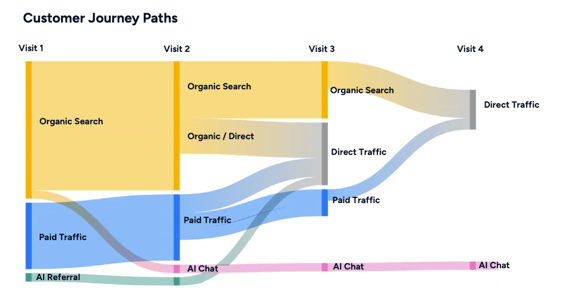
The good news is that both SEO and AEO are measurable. The less comfortable truth is that measuring them properly requires you to stop treating traffic as the end goal and start working backwards from pipeline value. In B2B, where buying cycles are long and decisions involve multiple people researching across multiple channels, conflating activity with commercial outcome is one of the most expensive measurement mistakes you can make.
How SEO measurement actually works, and where it breaks down
Traditional SEO has a relatively clear line from search engine to commercial result. Someone searches for something relevant, your content appears, they click, they land on your site, and at some point they take an action. Google Search Console tells you what they searched and how often they clicked, and since mid-2026 its Generative AI performance report shows separately how often your pages turned up inside AI Overviews and AI Mode. GA4 tells you what they did when they arrived. Your CRM tells you whether any of them became a lead, a qualified opportunity, or a customer.
The standard ROI calculation is straightforward: take the pipeline value or revenue attributable to organic search, subtract what you spent on SEO (agency fees, content creation, tooling), and divide the result by that cost. The harder part is making sure your CRM is configured to capture the full journey rather than just the first or last touchpoint.
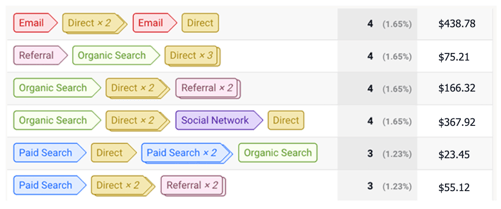
Where B2B SEO measurement typically fails is at the attribution layer. Most businesses know which contacts came from organic search at the point of form submission and credit that last touch, without accounting for the number of touchpoints that contact moved through before arriving there. That is a fair omission. You probably cannot pin down the exact direct number. But you can infer attribution, and you can build models that help you evaluate each channel and its role in driving a contact toward conversion.
The AEO problem: your buyer is already being answered before they reach you
AEO presents a fundamentally different measurement challenge, and pretending otherwise will lead you to underinvest in it or misread its contribution.
When a buyer types a question into ChatGPT, Perplexity, or Google's AI overview, they often receive a direct answer without visiting any of the sources cited. If your brand is mentioned in that answer, you have influenced their thinking. If a competitor is mentioned instead, you have lost ground. Neither of those events shows up in your traffic data, your form submissions, or your pipeline report. They simply happen, quietly, while your dashboards tell you nothing. In the first four months of 2026, 68 percent of US Google searches ended without a click. Two years earlier it was 60 percent. Pew Research, which watched 900 US adults browse, found the same pattern from the other side: people clicked a search result 8 percent of the time when an AI summary appeared, and 15 percent of the time when it did not.
This is sometimes called the dark funnel, though a more useful frame is this: the buyer's research process has become partially invisible. That does not mean you cannot measure AEO's contribution. It means you have to measure it differently.
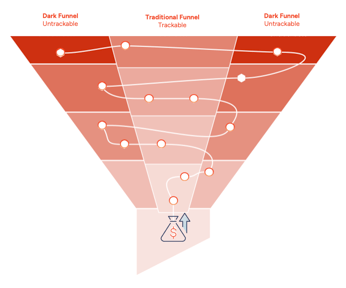
1. The first and most directly trackable signal is referral traffic from AI platforms. Analytics tools are evolving fast and are already beginning to surface this traffic natively: some platforms label it AI Referrals, others AI Assistant. When a buyer does click a citation link from ChatGPT, Perplexity, or a similar engine, that visit is attributable. This is a real and growing cohort, but the probability of that click is low, and it underrepresents total AI influence by a significant margin. Remember: the objective is not traffic to your website. All the information a customer wants is being gathered outside it. It can also mislead in the other direction. AI referral traffic converts well, but much of it is navigational: the buyer had already decided and asked the assistant for the link. A strong conversion rate tells you the traffic is late-stage, not that AEO created the opportunity.
2. The second signal is brand visibility. This is your brand's presence in AI-generated answers, measured by how often it is mentioned relative to the median number your competitors receive across the same queries. It can be tracked using a growing range of tools, and it can be actively influenced through AEO work: structuring your website and content so that AI engines can read, index, and draw from it with confidence. You can now pay for placement too. OpenAI's ChatGPT Ads Manager is open to advertisers, and it buys you a sponsored card below the answer, clearly marked as an ad. It does not buy you a place inside the answer. OpenAI says its ads run on separate systems and do not change what the model tells people. What makes the signal increasingly complex is share of models: your brand's visibility is now spread across ChatGPT, Perplexity, Gemini, Claude, Copilot, and every new AI tool entering the market. That landscape is expanding fast, and each engine has its own sources, logic, and weighting. Tracking brand visibility means tracking it across all of them, not just the one with the largest user base today. Treat the numbers these tools give you with some caution. Ask the same engine the same question twice and you will often get a different answer, which means "a dashboard reading 17.4 percent share of voice, up two places this week" is more precise than the data behind it. Pick a tool that lets you see the raw answers behind the score, and report whether your position is improving rather than the decimal.
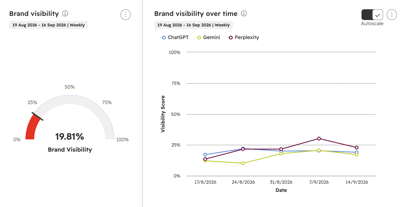
AEO Dashboard on HubSpot
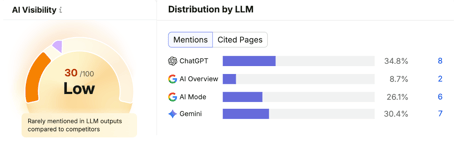
AI Visibility Tool on Semrush
3. The third signal is mentions and citations, and this is arguably the most important of the three. A mention is when an AI engine references your brand by name in a generated answer. A citation is when it links back to your content as a source. The distinction matters: citations signal that an AI system considers your content authoritative enough to surface as evidence, not just relevant enough to name. They are also partially trackable through referral data when a user follows the link. Monitoring how frequently your brand is cited, which content earns citations, and whether your citation share is growing or declining relative to competitors tells you something no traffic report can: whether AI engines trust you as a source. This is the foundation of AEO. Everything else builds on it.
For Google's surfaces there is one figure you do not have to buy. Search Console's Generative AI performance report counts how often your pages appeared inside AI Overviews and AI Mode, so unlike a sampling tool it gives you a count rather than an estimate. It stops short of clicks, click-through rate and queries, so read it as a visibility number and not as a measure of return.
Measuring both together: the attribution model that actually works in B2B
The frame for measuring SEO and AEO return should be pipeline value, not traffic volume, and this distinction is more important now than it has ever been. AI is actively moving your content outside your trackable territory. By the time a buyer lands on your website, most of their questions have already been answered. They arrive ready to act, not ready to browse. That means visitor numbers may drop. That is not failure. If your strategy is working, the number of deals will increase.
The deeper issue is that direct, last-touch attribution is structurally inadequate for B2B buying behavior. The average B2B deal involves more than eight touchpoints across multiple channels, at least three decision-makers from different parts of the business, and rarely fewer than three weeks of active evaluation. No single channel closes a deal. What you need is a cross-channel attribution model that assigns weighted relevance to each channel based on its actual role at each stage of the decision journey, rather than giving all credit to the first or last interaction.
A data-driven attribution model, increasingly supported by AI-assisted analysis, proportionally distributes credit across all the channels that contributed to a conversion, weighting each by how often it turns up in journeys that ended in a sale compared with ones that did not. This is a more honest and commercially useful picture than any single metric will give you. It still cannot tell you whether those channels caused the sale or were simply present for it.
Setting this up in HubSpot
If HubSpot is your CRM, you have most of what you need already. The configuration work is specific and not particularly complex, but it requires intention.
HubSpot offers two types of pre-built attribution reports that serve different purposes. The first measures impact by contact, showing which sources, content assets and interactions had the greatest influence on generating leads. The second, available in the Advanced Marketing Reports, measures impact by deal, connecting touchpoint performance to revenue through customer journey and multi-touch attribution reports. Used together, they give you visibility across both the lead generation layer and the commercial outcome layer, which is the combination most businesses are missing.
HubSpot classifies visits from AI assistants under its own AI Referrals traffic source, and names the platform in traffic source drill-down 1. Three reports are worth building: AI-referred sessions by platform, contacts whose Original Source is AI Referrals, and deals with an AI Referrals touch anywhere in the path.
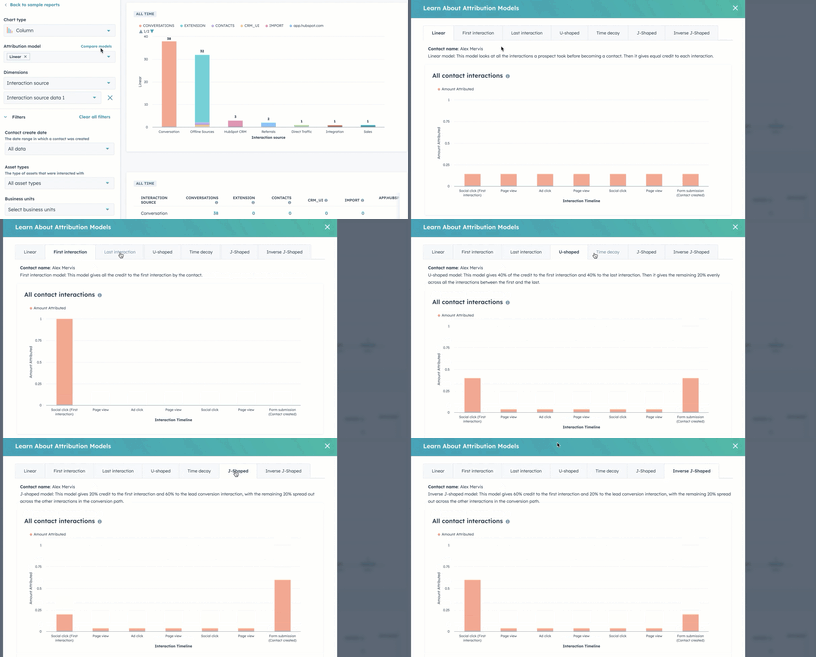
HubSpot's multi-touch attribution is powerful within the boundaries of what it has actually tracked. It can look across a contact's full recorded journey, applying different attribution models (first touch, last touch, linear, or weighted) to show which channels contributed to a deal, not just which one closed it. That is genuinely useful for SEO measurement and absolutely necessary for building customer relationships for the long run.
But it cannot infer what it never saw. It works from the first tracked session forward, meaning anything that happened before that contact appeared in your system is invisible to it. The dark funnel does not become visible. HubSpot tells you an accurate story about what it can see. The problem is that in an AI-influenced buying journey, a significant part of the story happens before anyone arrives. That is why the numbers need to be read with this limitation in mind – and why you need another way to see what happened before the buyer reached your website.
There is one signal your CRM cannot produce on its own, and it is the one that reaches into the part of the journey you cannot see. Ask the buyer directly. A short open-text question on your demo and contact forms, asking how they first heard about you, picks up the conversations that happened in ChatGPT, in a private Slack channel, or at an industry event. Keep it as free text rather than a dropdown, because a dropdown tells people which answers you were expecting. Someone then needs to read and sort those responses each week into a consistent set of categories, with AI assistants as one of them, and store the result against deal value. Buyers misremember, so give it two quarters before you read a trend into it. Even allowing for that, it is the only view you will get of influence that never produced a click.
The bigger commercial risk is treating zero-click invisibility as invisible results. If your competitors are being cited in AI answers and you are not, that gap is compounding over time. You are not losing traffic. You are losing the recommendations.
Frequently Asked Questions
How do I make my website readable and citable by AI engines?
There are two layers to this. The first is technical access: check that your robots.txt file is not blocking AI crawlers such as GPTBot, ClaudeBot, or PerplexityBot, and ensure your pages load cleanly with structured markup. The second is authority: write direct answers to the questions your buyers are actually asking, stay focused on a defined set of topics, and earn references from credible third-party sources. AI engines surface content they consider trustworthy. You cannot control which answers they include you in, but you can control how easy you make it to find you, read you, and trust what you say.
Can you really measure AEO return, or is it mostly brand awareness?
You can measure a meaningful and growing portion of it across three distinct signals. The first is referral traffic from AI platforms, which is trackable when a buyer follows a citation link. The second is brand visibility: how often your brand is mentioned in AI-generated answers relative to competitors, across the full range of engines from ChatGPT to Gemini to Perplexity. The third, and most commercially significant, is mentions and citations. A citation means an AI engine considers your content authoritative enough to surface as evidence. That is not brand awareness in the traditional sense. It is a measurable indicator of trust, and it has a direct relationship to whether buyers encounter you or a competitor when they ask the questions that matter most.
What is the difference between a mention and a citation in AEO?
A mention is when an AI engine names your brand in a generated answer. A citation is when it links to your content as a source. Citations carry more weight because they signal that the engine treats your content as authoritative, not just relevant. They are also partially trackable through referral data when a user follows the link. If you are monitoring one metric to understand your AEO position, citation share is the one that tells you whether AI engines trust you as a source.
My website traffic is dropping. Does that mean my strategy is not working?
Not necessarily, and in an AI-influenced market it may mean the opposite. AI engines are answering buyers' research questions before those buyers ever visit your site. By the time someone lands on your page, most of their questions have already been answered and they are closer to a decision. If your AEO is working, fewer people will arrive mid-research, but the people who do arrive will be more ready to act. The number to watch is not sessions. It's deals.
Can I build a HubSpot report that shows AI channel performance?
Yes, and in two places rather than one. For traffic, HubSpot classifies AI assistant visits under its own AI Referrals traffic source, which carries through to Original and Latest Traffic Source on the contact, so you can tie it to deals and revenue. For visibility, HubSpot AEO tracks how often you are mentioned and cited across ChatGPT, Gemini and Perplexity. Between them they cover both halves: the buyers who clicked, and the ones who only saw your name in an answer. What neither can do is join the two, which is what a "how did you hear about us" field on your forms is for.
Where do I start if I want to measure AI's influence on my pipeline?
Start with the two things that cost nothing and take a week: add the open-text "how did you hear about us" field to every high-intent form, and open the Generative AI performance report in Search Console to see which pages Google is already pulling into AI answers. Then move to your attribution reports: connect lead sources to deal-level revenue so you can see which channels are generating commercial conversations, not just traffic. Then look at your referral traffic and identify visits coming from AI platform domains. Only then pay for a tool that tracks brand visibility and citation share across the major AI engines, because the earlier steps will tell you whether you have a visibility problem worth monitoring. It requires someone who owns the data, reviews it consistently, and understands the difference between what is being measured precisely and what is being estimated directionally. If you use HubSpot, you already have the pre-built tools to get started.
Working out what your search and AI visibility is actually worth is the part most teams get stuck on. It is also most of what our B2B SEO and AEO work involves: connecting visibility to pipeline rather than to sessions. If you want a clearer view of what your reporting captures today and what it is missing, book a consultation.




.png)




-1.png?width=19&height=19&name=Vector%20(3)-1.png)

.png?width=19&height=16&name=Vector%20(4).png)

.png?width=18&height=24&name=Vector%20(5).png)