.png)
If you are new to setting up a ChatGPT Ads campaign, you may think ChatGPT's Ads Manager looks familiar enough that you could build a campaign the same way you'd build one on Google Ads or LinkedIn Campaign Manager, using the same instincts and the same defaults. That approach will cost you here, because several settings inside ChatGPT Ads look completely out of the box but aren't actually configured for your goal until you change them. Our guide to setting up your first ChatGPT Ads campaign covers the fundamentals: access, campaign structure, and writing your first context brief. This article goes deeper into the settings that guide only touched on: campaign type, the Conversions objective, location and platform targeting, custom audiences, tracking, and how to actually research what to say.
Standard vs. Product Feed: Which Campaign Type Should You Use?
OpenAI Ads Manager offers two campaign types.
1. Standard: built for advertisers who create each ad manually: a title, a description, a destination link, and an image.
2. Product feed: a newer format, added in mid-2026, that generates ads automatically from an uploaded catalog.
Per OpenAI's own documentation, product feed campaigns let retail advertisers upload a product feed and create ads based on that catalog, and the format is designed specifically for retail advertisers with broad or frequently changing product ranges.
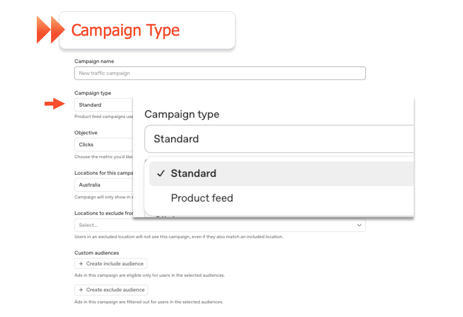
If you're advertising a service rather than a product catalog, which covers most B2B teams, Standard is the only real option. Product feed will appear in the dropdown as a valid choice, but it isn't built for you, and forcing a services offer into a catalog format won't work around that.
The Conversions Objective Only Works If You Define the Conversion First
The Objective dropdown offers Reach, Clicks, and Conversions. For most of the platform's beta period, click-based bidding was the only real option, which meant advertisers had to treat clicks as a proxy for results rather than a direct measure of them. Conversions changes that: the system optimizes delivery toward the action you actually care about.
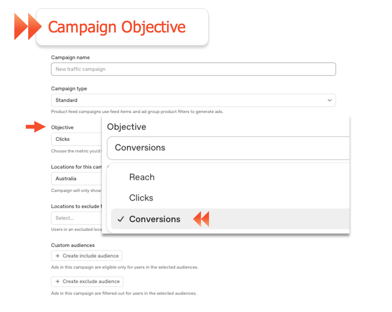
The catch is the Conversion event field underneath it. It looks optional. Selecting Conversions as your objective without defining what a conversion is on your site means the platform is optimizing toward nothing in particular.
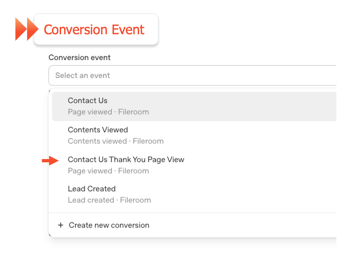
If your goal is lead generation, the strongest conversion event to track is a dedicated thank you page that loads only after a form submission, not a page-view event on the contact page itself. A page view tells you someone looked. A thank you page tells you someone filled in a form. If you don't have one for your main conversion path yet, build it before the campaign launches, not after.
How Far Can You Actually Get With Location Targeting?
You can include specific locations for a campaign and separately exclude others, and an exclusion overrides an inclusion wherever the two overlap. The granularity behind that depends heavily on which country you're advertising in.
Currently, the ChatGPT Ads Manager supports campaign-level country targeting, and in the United States it additionally supports state, designated market area (DMA), and ZIP code targeting. That US-specific granularity was only added in May 2026 and did not exist at launch.
OpenAI doesn't publish a clear breakdown of what's available beyond the US, the location picker itself is more granular than the documentation suggests for some countries, showing city or region-level options rather than country only.
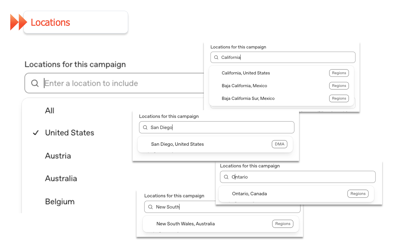
This is an area OpenAI is actively building out, not a fixed feature set, so the depth available in your target country today may not match what was true a month ago. The practical move is to search for your specific country directly in the location picker when you build the campaign and see how far down it lets you go.
"Eligible Platforms" Isn't a Device Setting
Eligible platforms lets you include or exclude iOS app, Android app, and Web. It's tempting to read this as a way to target desktop over mobile, especially for B2B, where most serious research happens at a desk during work hours. The setting doesn't let you act on that directly.
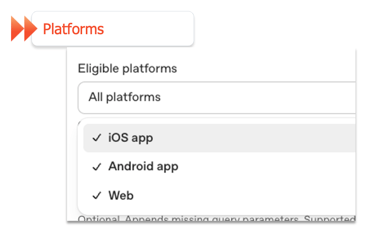
Per OpenAI's help documentation, Web includes both desktop web and mobile web, and Insights currently group device reporting into Mobile and Desktop, with mobile web counted under Mobile. Deselecting Web to try to exclude mobile traffic would also cut off desktop entirely, and there's no toggle that isolates one from the other at the targeting level.
If desktop performance matters to your business case, don't try to force it through Eligible platforms. Check the Mobile and Desktop split in reporting once the campaign has run, and use that to inform budget, not the setup itself.
Custom Audiences: Strong for Suppression, Limited for Targeting
Custom audiences let you create an audience to include or one to exclude, uploading raw or SHA-256 hashed emails and phone numbers as a CSV or TXT file, which OpenAI normalizes during processing.
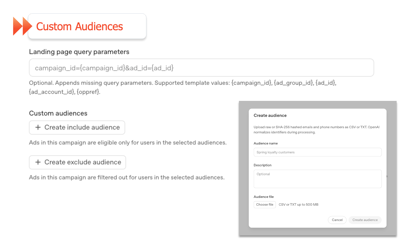
This is genuinely useful for excluding existing customers from prospecting spend. It's weaker on the include side. The email or phone number a business holds for a contact is usually a work identifier, and that's frequently not what the same person used to create their ChatGPT account, which tends to be personal. If you're uploading a B2B contact list, expect a modest match rate on the include side, since there's no published benchmark from OpenAI to set expectations against yet. Treat the feature as a suppression tool first and a targeting tool second.
➡️ None of that changes the more important rule. Never upload a contact list without confirmed authorization to use it for advertising. Consent comes first, always.
Creative and Targeting: What Actually Moves the Needle
Three things about messaging and targeting are easy to get wrong by defaulting to habits from other platforms.
1. Image: The image doesn't need to be a lifestyle photo. Ads render as a small, clearly labeled card beneath a conversational answer, not inside a scrolling visual feed, so a clean, square version of your logo tends to do more work than stock photography.

2. Prompt Research: The research behind your messaging shouldn't start with a keyword tool. SEMrush and similar tools describe what someone types into a search box, but ChatGPT Ads matches ads to conversations, not queries. A stronger starting point is AEO-style prompt research: identify the actual questions driving traffic, both to your own site and across a meaningful set of competitors, and build messaging around the highest-intent prompts rather than the highest-volume keywords.
3. Context: That same shift applies to the context hint itself. Our first guide covers the basics of writing one: describe the conversation, not the demographic. The most important layer is the exclusion. A context hint built for commercial intent states the campaign's objective, defines the audience by industry and situation, lists the topics and questions to prioritize, and then explicitly excludes the academic, educational, or DIY-only questions that share a topic but not a budget. That last layer is what separates someone writing a university assignment from someone with a live problem and the authority to solve it.
Recent Platform Changes Worth Knowing About
ChatGPT Ads is changing fast enough that anything written about it needs a timestamp. A few updates are worth building into how you set up a campaign right now.
-
Bidding has become more automated. Maximize results is a bid strategy that lets ChatGPT Ads automatically set and adjust bids on your behalf, designed to return as many results as possible from a given budget, and it's now the default for new ad groups. Reporting added one-day view-through conversions, which count a conversion when it happens within a day of an ad impression and no click gets credit for it first, giving a directional read on influence beyond the click without changing how bids are optimized.
-
Measurement is also extending outward. Advertisers can now connect ChatGPT Ads performance to a WorkMagic dashboard alongside other channels, and feed conversion signals back to OpenAI through the Conversions API, useful for seeing this channel in the same view as the rest of the media mix rather than as an island.
And the map keeps growing. Ads Manager is now live in nine markets, the United States, United Kingdom, Canada, Australia, New Zealand, Japan, Korea, Brazil, and Mexico, with 31 European countries listed as coming soon (or before 2026 ends).
If you're setting up a ChatGPT Ads campaign and want a second pair of eyes on it before it goes live, that's exactly the kind of conversation Fileroom is glad to have. Get in touch.
Frequently Asked Questions
How much do ChatGPT Ads actually cost?
As of mid-2026, most advertisers are bidding USD $3 to $5 per click on CPC, or USD $25 to $60 per thousand impressions on CPM, with software and finance running higher and ecommerce running lower. Pricing has dropped sharply since launch and is still moving, so treat any number here, including this one, as a snapshot rather than a fixed rate card.
Is there a minimum spend to get started?
No, or best, not yet. A campaign can run on a daily budget in the tens of dollars. That's likely to shift as the platform matures and demand increases, the way early access tiers and pricing floors have already moved more than once this year, so don't assume today's low barrier to entry is permanent if you're planning budget further out.
Do the ads influence what ChatGPT actually tells the user?
No. OpenAI has confirmed that ads never influence ChatGPT's own answers. The ad appears as a separate, clearly labeled sponsored card, not as part of the model's response.
How does the ad auction actually work?
It's a relevance-weighted, second-price auction, meaning ad quality and topical fit affect who wins, not just who bids highest. Bids that sit noticeably below the going rate tend to fail to clear the delivery threshold entirely rather than simply underperforming.
Does a "click" on a ChatGPT ad always mean someone left the app?
Not necessarily. Depending on how the ad is configured, a billable click can include expanding the sponsored content or engaging with it inline, not only navigating away to your website. Worth keeping in mind when you're comparing CPC here against a channel where a click only ever means one thing.
Related articles:
How to Set Up a ChatGPT Ads Campaign
ChatGPT Ads in Australia: What a Month of Real Campaign Data Showed




.png)




-1.png?width=19&height=19&name=Vector%20(3)-1.png)

.png?width=19&height=16&name=Vector%20(4).png)

.png?width=18&height=24&name=Vector%20(5).png)