If you run marketing for a B2B company, chances are ChatGPT Ads is not on your roadmap. The platform is still in beta, there are no established benchmarks, and few case studies to learn from. But a growing share of B2B buyer research is happening inside AI platforms before a website visit or a search query ever enters the picture. That is precisely why it is worth testing now rather than later.
Every new ad channel is unproven until enough advertisers test it and the data becomes common knowledge. By the time benchmarks exist, your competitors have already learned what works and captured the early advantage.
As a growth agency, testing emerging channels before our clients invest in them is part of the job. We take on the early experimentation so our clients can benefit from real-world learnings. So, we put a modest daily budget behind a month-long ChatGPT Ads Australia campaign targeting B2B industrial and technical buyers. We measured not just the usual media metrics but something we have not seen anyone else track: how advertising inside ChatGPT influences a brand's visibility in ChatGPT's own answers.
This is the first of a three-part series. Here is what the data showed in flight one. Part two will cover how to set up a ChatGPT Ads campaign in the platform, and Part three will outline what happened when we paused the campaign and then switched it back on again.
Is there enough B2B inventory on ChatGPT Ads?
This was our biggest doubt going in. We target a narrow slice of the market: B2B companies with complex products, long sales cycles and technical buyers. It seemed plausible that ChatGPT simply would not find enough of those conversations in Australia to spend a budget against.
The concern turned out to be unfounded. The campaign spent roughly 95% of its daily budget across the flight and delivered more than 46,000 impressions, indicating that our budget ran out before the relevant conversations did. For marketers wondering whether the channel is too early or too thin for niche B2B, the evidence suggests otherwise: the audience is already there.
What Does ChatGPT Advertising Cost in Australia?
Our average cost per click landed just under A$6, with CPMs in the low thirties. That places ChatGPT Ads in similar territory to LinkedIn rather than search, and it is worth setting that expectation with leadership before anyone anchors on Google-level costs. Click-through rates ranged between 0.4% and 0.8% depending on the audience theme, which is in line with cold B2B display benchmarks. For a first flight using untested creative on an untested platform, we consider that a strong starting point.
What the premium buys is context. The ad appears inside a conversation someone is actively having about a problem you solve, rather than in a feed they are scrolling past. Whether that context produces better-qualified clicks than LinkedIn is a question our next flight is designed to answer, and we would caution anyone against assuming it does until the lead-quality data exists.
How does targeting work without audiences or demographics?
ChatGPT Ads, at this stage, has no firmographic or demographic targeting. Each ad group instead carries a written brief describing the conversations your ads should appear in: the industries, the buyer roles, the enquiry types to prioritize and the ones to avoid. Across our ad groups, delivery visibly followed these briefs, and impression volume tracked how much conversation exists per theme.
For a marketer, this changes where the effort goes. There is no audience builder to configure; the leverage sits in how well you can describe your buyer's actual conversations in writing. That is a skill closer to messaging strategy than media buying, nobody has documented it yet, and we have now built and tested our own approach across multiple audience themes.
The measurement trap nobody warns you about
This is the finding we most wish someone had published before we started. Conversion tracking on ChatGPT Ads is entirely on the advertiser, and the defaults will quietly fail.
The platform lets you launch without attaching conversion events. Combine that with shortened redirect links and ChatGPT's in-app browser, and you can accumulate hundreds of clicks with almost nothing attributed on the other side. We learned this firsthand: healthy click volume, near-zero attributed sessions, and a day of forensic work to find the cause.
For anyone whose credibility depends on reporting results to leadership, this is the single most important thing to know about the platform. A campaign that cannot attribute its clicks is a campaign you cannot defend in a quarterly review, whatever its real performance was.
Did advertising on ChatGPT change our visibility in AI answers?
We track brand visibility in AI-generated answers every week, for our own brand and for our clients, across ChatGPT, Gemini and Perplexity, using HubSpot's AEO dashboard, Semrush (and a third tool we are keeping to ourselves for now). That discipline is what made this experiment possible: we had weeks of clean baseline data before the campaign launched, so we knew exactly what normal looked like.
The week our ads went live, our ChatGPT visibility jumped. Within a fortnight it had roughly tripled against its pre-campaign average, while our visibility on Gemini and Perplexity, where we were not advertising, did not move in step. The lift was specific to the one platform carrying our ads, and it began the exact week they started.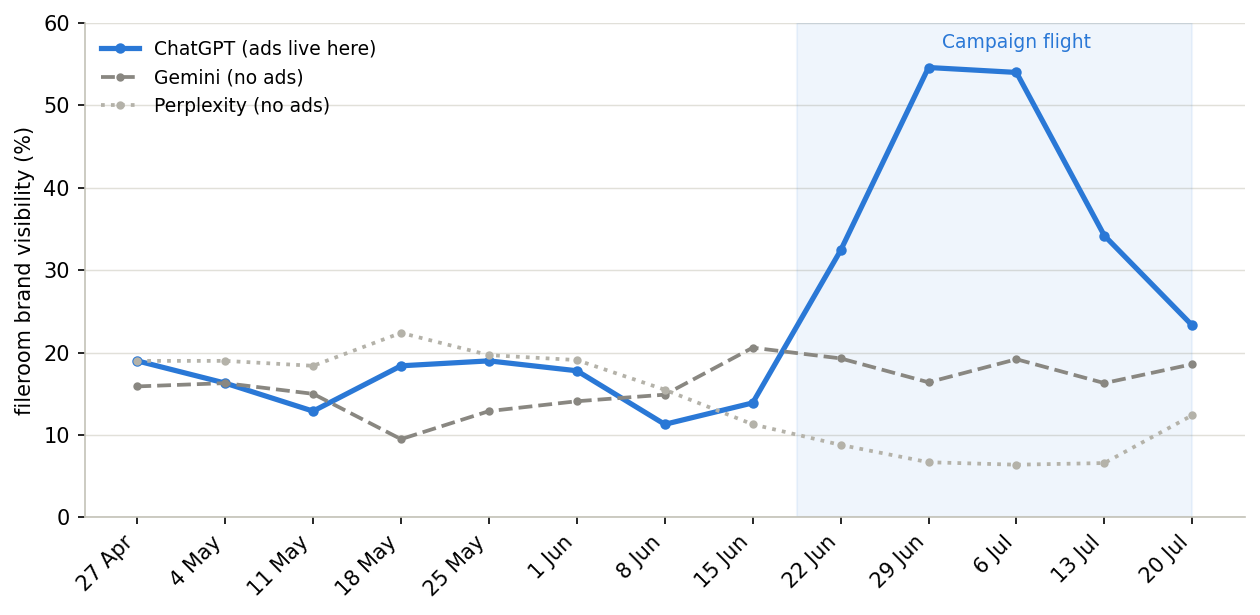
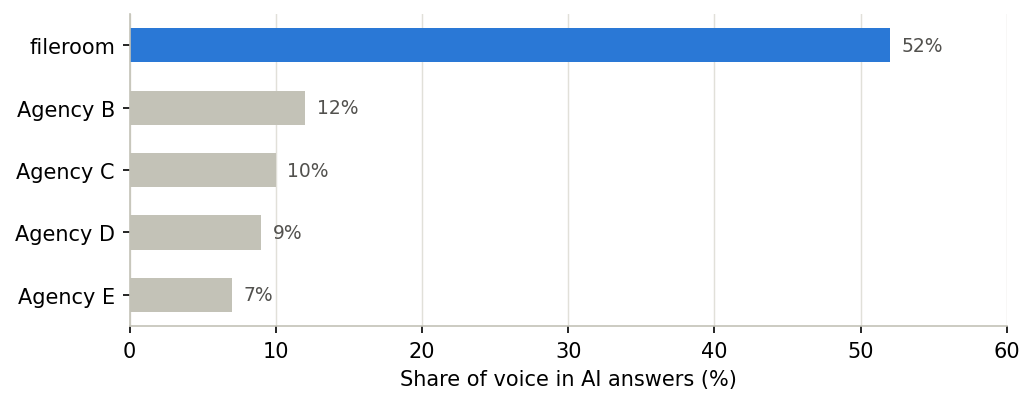
The competitive picture told the same story. Our overall visibility in AI answers climbed to an all-time high during the flight while the agencies we benchmark against stayed flat, and we finished the period holding a majority share of voice in our competitive set.
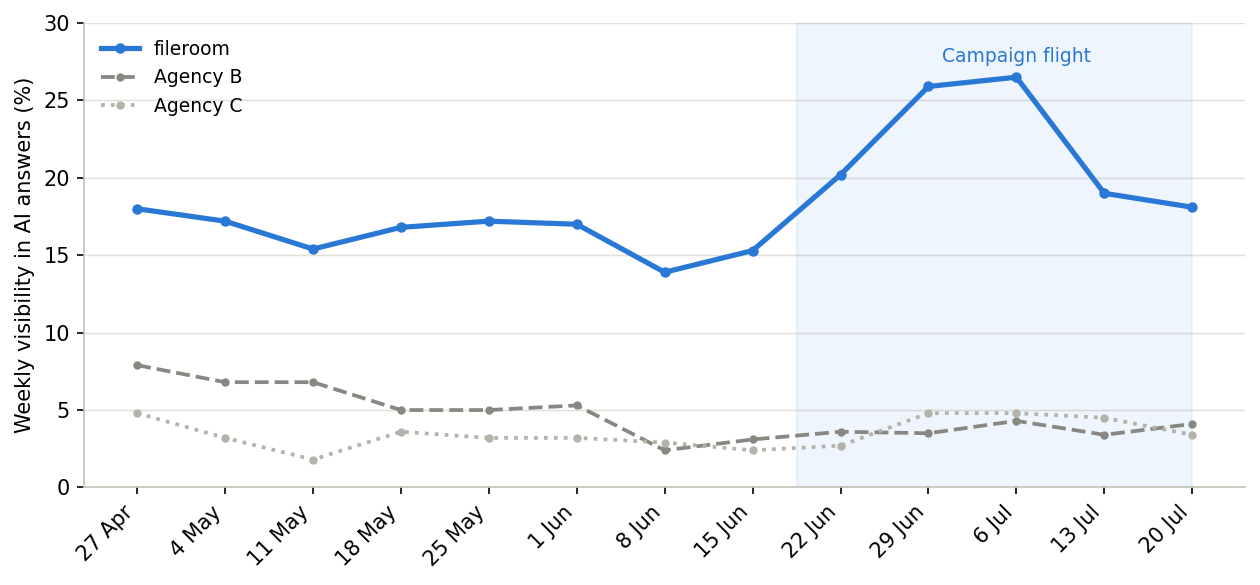
We are deliberately not declaring victory on causation. There are competing explanations, including how visibility tracking tools sample AI responses, and the effect softened in the flight's final weeks. For the same reason, we have deliberately left the campaign's effect on overall website traffic out of this analysis: with attribution not yet properly configured and several unrelated factors moving our traffic over the same period, any claim we made there would be guesswork dressed as data. We would rather report that honestly than pad the results, and we will revisit traffic impact once tracking is rebuilt and a second flight gives us cleaner numbers.
So we are doing what we would do for any client: running the experiment properly. We have paused the campaign, we are watching whether visibility falls back toward baseline, and we will then resume to see whether it lifts again. An on-off-on pattern is hard to explain away as coincidence, and we will publish the result either way. Part two of this post will cover it.
The strategic takeaway
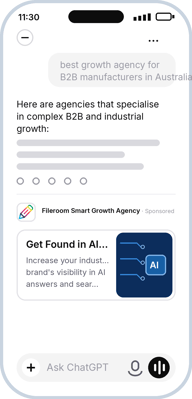
ChatGPT Ads offers a premium, top-of-funnel conversational channel with real inventory, LinkedIn-level costs, targeting that rewards messaging skill over media mechanics, and measurement that only works if you build it yourself before spending. The most interesting question it raises, whether paid presence affects your brand's standing in AI answers, does not yet have a settled answer, and anyone claiming otherwise is ahead of their evidence.
If you are weighing the channel up for your own B2B brand, or you want your visibility in AI answers measured properly before and after anything you try, that is the work we do every day. We are happy to share what a structured pilot on your budget would look like. Book a free consultation with our expert team today!
Frequently Asked Questions
How much do ChatGPT Ads cost?
Based on our pilot, expect a cost per click of around A$6 and CPMs in the low A$30s for B2B targeting in Australia, which is comparable to LinkedIn rather than Google Ads. Pricing will vary with competition and targeting, and as one of the first campaigns on the platform our figures represent an early, low-competition market. Costs may rise as more advertisers arrive, which is another argument for testing sooner rather than later.
Does advertising on ChatGPT improve your visibility in AI answers?
It is too early to say definitively. In our pilot, our ChatGPT visibility roughly tripled the week ads went live while our visibility on Gemini and Perplexity stayed flat, which is a striking and platform-specific correlation. However, the effect softened late in the flight and measurement artifacts cannot yet be ruled out, so we are running a pause-and-resume experiment to test causation and will publish the result. Fileroom tracks AI answer visibility weekly for our own brand and for clients as part of our AEO service, so we can measure this for your business before you spend a dollar on the channel.
Are ChatGPT Ads worth it for B2B companies?
It depends on what you need it to do. As a top-of-funnel channel it already offers real inventory, precise conversation-level context and early-mover pricing, but it has no firmographic targeting, shallow reporting, and no proven lead-quality data yet. Our view is that it warrants a small, structured pilot for B2B brands whose buyers research complex purchases but does not yet warrant a major budget commitment from anyone.
How does targeting work on ChatGPT Ads?
Through written briefs called context hints rather than audience segments. Each ad group carries a description of the conversations the ads should appear in, covering industries, buyer roles and enquiry types to prioritize or avoid. Writing these briefs well is the main skill the channel rewards, and it is closer to messaging strategy than traditional media buying. Fileroom has developed and tested its own approach to writing these briefs across multiple B2B audience themes during our pilot, and it is part of what we bring to client campaigns on the platform.
How do you track conversions from ChatGPT Ads?
You must attach conversion events in Ads Manager before launch, use direct destination URLs with full UTM parameters rather than link shorteners, and verify attribution with test clicks from inside the ChatGPT app on both mobile and desktop. The platform will let you launch without any of this, and if you skip it your clicks will arrive with little or no attribution. This was the most expensive lesson of our pilot and the easiest one for you to avoid.
Should my business be measuring AI answer visibility?
Yes, if AI assistants are part of how your buyer's research. A growing share of B2B purchase research now happens inside ChatGPT, Gemini and Perplexity, and brands that appear in those answers are effectively being shortlisted before a website visit ever happens. Fileroom runs AI visibility and AEO programmes for B2B companies, including weekly tracking against competitors, and our own 52% share of voice in our competitive set is the result of that same methodology applied to ourselves. If you would like to know where your brand stands in AI answers today, get in touch and we can show you.
Fileroom is a B2B smart growth marketing agency and HubSpot Diamond Partner specializing in AI-enabled sales and marketing, and growth for industrial and technical companies. This post is part one of three; part two covers how to set up a campaign in ChatGPT Ads and part three outlines the results of our pause-and-resume visibility experiment.



.png)



-1.png?width=19&height=19&name=Vector%20(3)-1.png)

.png?width=19&height=16&name=Vector%20(4).png)

.png?width=18&height=24&name=Vector%20(5).png)