Your buyers are not Googling the way they used to. A growing share of B2B purchase research now begins inside ChatGPT, and most marketers have not noticed it yet because it does not show up in your traffic analytics. It's happening at the top of the funnel, quietly, before a website visit ever occurs.
ChatGPT Ads is live and available to buy. There are no published benchmarks, almost no case studies, and most competitors have yet to discover the channel. That’s exactly where the opportunity lies.
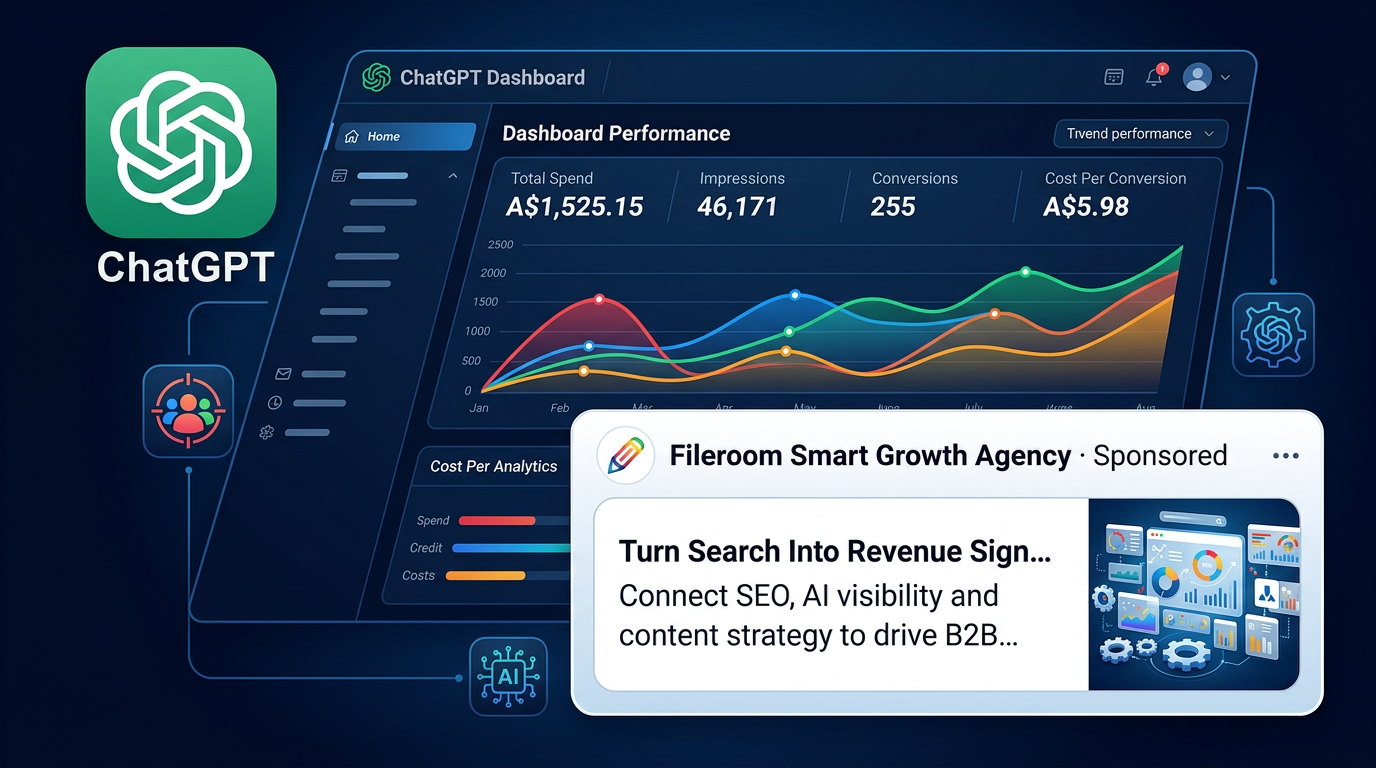
We ran a month-long pilot targeting B2B industrial and technical buyers in Australia (our ChatGPT Ads Australia campaign results). Our brand visibility inside ChatGPT roughly tripled against our pre-campaign baseline while our competitors stayed flat. That did not happen by coincidence. It happened because we studied the platform carefully before spending a dollar on it. This guide covers what we learned about setup.
Can you access it?
OpenAI has opened ChatGPT Ads Manager to self-serve onboarding. Eligible businesses in Australia, the United States, Canada, Japan, Korea, New Zealand and the UK can now apply directly without waiting for an invitation. This is a meaningful shift: until recently, the channel was limited to a closed group of pilot advertisers (Fileroom was one of only a few in Australia).
Availability does not mean you can launch tomorrow. The platform is still in beta, and each new advertiser goes through a review queue: you create an account, complete business verification, set up billing and submit your details for OpenAI to assess against its advertising policies. Approval is not immediate. How long it takes depends on the queue at the time you apply, so there is a genuine argument for submitting sooner rather than waiting until you have a campaign ready to run.
One distinction worth knowing: ads are shown to eligible adult users on Free and Go plans, which represent more than 80% of the total ChatGPT user base.
Start with context, not audiences
ChatGPT Ads has no firmographic targeting. No job titles, no company size, no LinkedIn-style segments. The platform does not know who is in a conversation. It only knows what the conversation is about.
Each ad group carries a written brief describing the types of conversations your ads should appear in. The platform reads the active conversation and decides whether it matches. The quality of your targeting is determined entirely by how well you write that brief.
The main lever on this platform is a context prompt. ChatGPT Ads introduces a fundamentally different way of segmenting audiences: instead of selecting filters, you instruct AI. You write a brief describing the conversations your buyers are having, and the platform decides whether your ad belongs there. Get the brief right and your ads reach the right people at exactly the right moment. Get it wrong and you spend budget on conversations that will never convert.
Segmentation prompts. What to include?
Describe the problem your buyer is trying to solve, not who they are. Cover the industry or sector, the implied buyer role (framed as language and intent, not demographics), the stage of the decision (awareness, evaluation, vendor selection), and the specific question types you want to show up for.
Don't forget to describe What to Exclude. Exclusions matter as much as inclusions. Without them, your budget reaches conversations that are adjacent to your topic but commercially useless. Name the specific conversation types you want to avoid, not vague categories like "personal use." The more specific the exclusion, the more reliably it works.
How to frame your intervention
Tell the platform the conversational context in which your ad is relevant: is the user evaluating options, looking for a recommendation, or searching for a provider in a specific region? That framing affects delivery. Treat your first brief as a hypothesis and review impression volume by ad group in week one. Low volume means the brief is too narrow. High volume with a poor click-through rate means the brief is matching conversations but the creative is not.
Campaign structure: campaign, ad group, ad
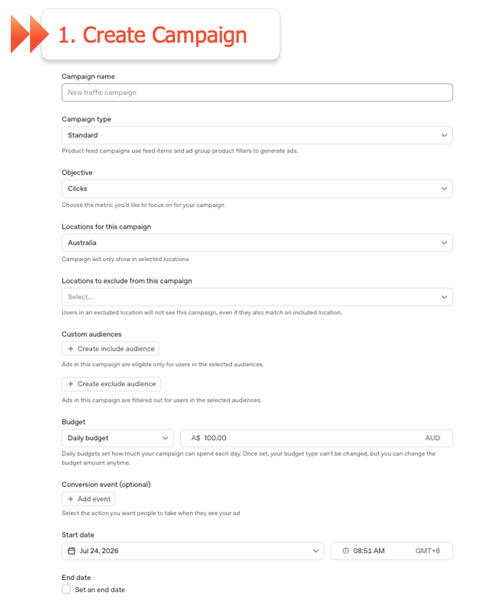
Campaign
Set a single commercial objective and a daily budget you can sustain for at least four weeks. A month of data is the minimum for meaningful patterns. Two distinct goals or audiences that need separate budget control belong in two campaigns, not one.
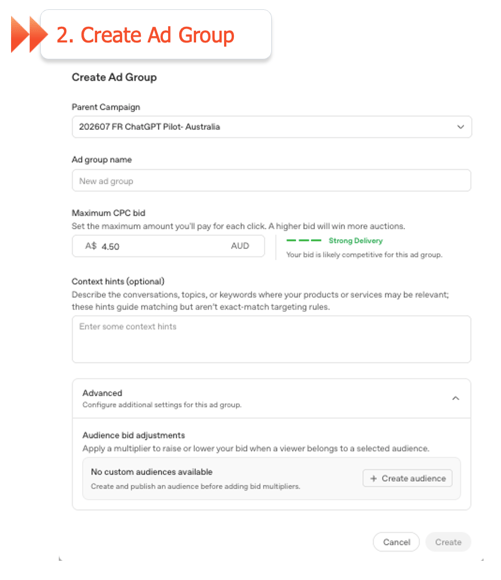
Ad group
Each ad group carries one context brief. Build separate ad groups for each distinct audience theme: different verticals, buyer stages or problem types. This lets you compare delivery across themes and learn where conversation inventory exists.
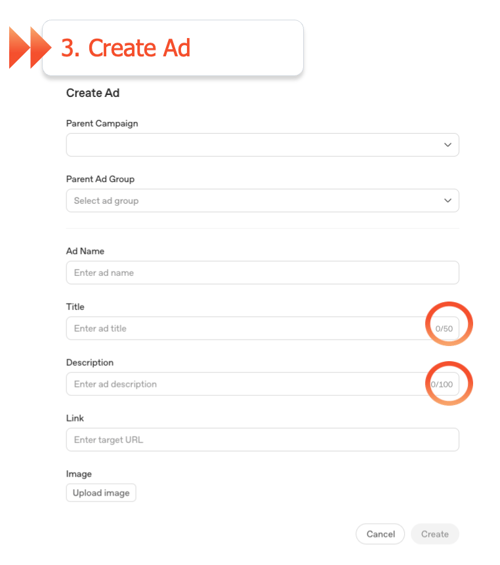
Ad
Each ad has three elements: an image, a title capped at 50 characters, and a description capped at 100 characters. Run at least two creative variations per ad group.
Write the title around the specific problem or outcome, not your brand name. "How to cut field service admin by 40%" does more work than "Field Service Management Software." The description should complete the thought, not repeat it. Tell the reader what the next step is and why it is worth taking.
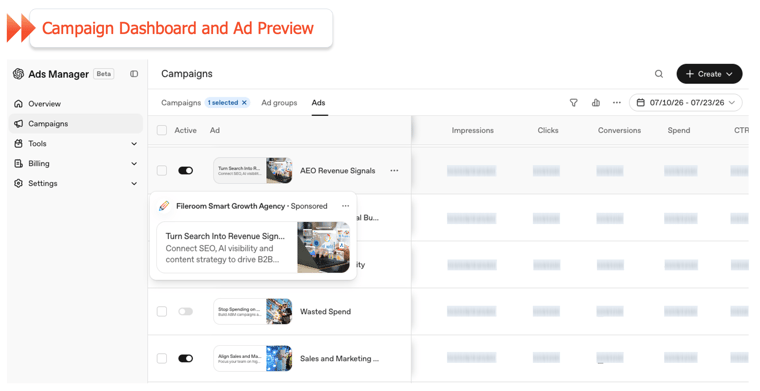
The image should be clean and legible at small sizes. ChatGPT's interface is text-heavy; an image with too many elements will not hold attention. Treat it as supporting context for the copy.
Daily budget
Based on our pilot, A$30 to A$50 per day is enough to generate meaningful impression volume for a niche B2B audience in Australia. At this scale the constraint is not inventory; it is the time needed to accumulate enough data to make decisions. Check impression distribution across ad groups in the first week rather than waiting a month.
Tracking: The right way to launch with confidence
ChatGPT Ads will let you launch without attaching any conversion events. If you do, you will accumulate clicks with nothing attributed on the other side and no way to report on what those clicks produced.
Before your campaign goes live, do three things.
1. Map your conversion events inside Ads Manager: consultation bookings, form submissions, demo requests, whatever represents a meaningful action.
2. Use direct destination URLs with full UTM parameters appended. Do not use link shorteners or redirect chains; they strip attribution through ChatGPT's in-app browser. Include utm_source, utm_medium, utm_campaign and utm_content at minimum.
3. Check and test. Click your own ad from inside the ChatGPT app on both mobile and desktop and confirm the session appears in your analytics with the correct source before spending anything.
The platform's native reporting is limited. Your CRM and web analytics are the source of truth for session-level and conversion data. If you are also tracking AI answer visibility, tools like HubSpot's AEO dashboard and Semrush give you a before-and-after comparison across ChatGPT, Gemini and Perplexity. The key is having a clean baseline before the campaign starts.
The strategic takeaway
ChatGPT Ads is not a channel to watch from a distance. The inventory exists, the costs are comparable to LinkedIn, and the window to test it before your competitors notice is open right now. What the platform does not do is configure itself. Attribution will not arrive automatically, targeting will not optimise without a well-written brief, and a campaign launched without a baseline visibility measurement gives you no way to know what changed.
We tripled our brand visibility in ChatGPT within a month, on a modest budget, by approaching the channel with an AI-Customer Experience optic. Structured, measured and built to produce results we could actually explain. Whether you are ready to test ChatGPT Ads or simply want to see where your brand stands in AI answers, we can help you understand the opportunity before you spend. Book a free consultation with our team and we will show you what a structured pilot on your own budget looks like.
Frequently Asked Questions
Who can advertise on ChatGPT Ads?
Businesses based in Australia, the United States, Canada, Japan, Korea, New Zealand and the UK can apply through self-serve onboarding in Ads Manager. The platform is still in beta, so access is approved through a rolling review queue rather than instantly. Each applicant completes business verification, billing setup and an OpenAI policy review before going live. Apply early, even if your campaign is not yet ready. Ads are shown to eligible adult users on Free and Go plans, which represent more than 80% of the total user base.
How do I write a context brief for ChatGPT Ads?
Describe the conversation your buyer is having, not who they are. Cover the sector, the problem being discussed, the stage of the decision and the type of questions you want to appear for. Include explicit exclusions for conversation types that share your keywords but represent the wrong audience. The brief is the primary targeting lever on this platform.
How many ad groups should I start with?
Two to four for a first pilot. Each represents a distinct audience theme. Too many ad groups spread a modest budget too thin to accumulate meaningful data. Too few means you cannot compare delivery across segments.
How do I track conversions from ChatGPT Ads?
Set up conversion events before launch, use direct destination URLs with full UTMs (no link shorteners), and test attribution by clicking your own ad inside the ChatGPT app before going live. The in-app browser behaves differently from a standard browser session and will silently drop attribution if your setup is not airtight.
Is it worth testing for B2B companies?
For brands whose buyers research complex purchases, yes. The inventory exists, the cost is comparable to LinkedIn, and the early-mover advantage is real. The caveat is that measurement requires deliberate setup before you spend. A campaign without proper attribution tracking will produce results you cannot explain or repeat.
Fileroom is a B2B smart growth marketing agency and HubSpot Diamond Partner specializing in AI-enabled sales and marketing. Part three of this series covers the results of our pause-and-resume visibility experiment. Follow us to be notified when it publishes.




.png)




-1.png?width=19&height=19&name=Vector%20(3)-1.png)

.png?width=19&height=16&name=Vector%20(4).png)

.png?width=18&height=24&name=Vector%20(5).png)