Your customers aren’t just Googling anymore. They’re asking AI.
Perhaps you’ve noticed your search traffic quietly declining. Or maybe your Google Business Profile isn’t generating the same level of views or enquiries it did not that long ago.
It’s easy to assume it’s a seasonal dip, another Google algorithm update, or something your marketing agency needs to fix. But the reality is different. You’re witnessing a fundamental shift in how people search for information online – and it’s already well underway.
Nearly half of all online research is now happening through AI assistants instead of search engines. AI sessions across ChatGPT, Gemini, and Perplexity are now running at 56% the volume of global search. For every two searches happening on Google, one person is asking an AI a direct question.
And in B2B and industrial markets, those questions are specific: "Which supplier can turn around a quote in 48 hours?", "What's the most reliable automation solution for a mid-size warehouse?", "Who are the leading providers of X in the city?"
The old game was ranking. The new game is being cited. They are not the same game.
The Misconception Worth Addressing
The usual approach is to assume that showing up in AI-generated answers is either automatic (if you rank on Google, you'll appear) or out of reach (it's a technical problem for the IT team to solve). Neither is accurate.
AI answer engines don't simply mirror search rankings. They prioritize content that is structured clearly, answers a specific question directly, and provides enough context to be cited with confidence. A page that ranks well for a keyword can still be invisible to an AI that's trying to answer a nuanced procurement question.
The operational gap here isn't a technology gap. It's a content and configuration gap, and it's one that most HubSpot Marketing Hub users already have the tools to close.
The Real Problem: You Can't Improve What You Can't See
Before any content optimization can happen, businesses need to know how they currently appear – or fail to appear – across AI platforms. Most don't. They're operating blind in a channel that is growing faster than any other form of buyer research.
HubSpot has responded to this directly. Answer Engine Optimization (AEO) tracking is now built into Marketing Hub, available across all account tiers. It monitors how your brand shows up across ChatGPT, Gemini, and Perplexity, identifies where competitors are being cited instead of you, and surfaces specific content gaps to address. The capability is there. The question is whether your team knows it exists and has it configured.
That's the starting point. Here are four quick wins that follow from it.
Quick Win 1: Activate AEO Monitoring in Marketing Hub
The first move is simply switching it on. HubSpot's AEO tools let you define the questions your buyers are likely asking AI systems – questions about your product category, your industry, your competitors – and then track whether your content is showing up in the answers those AI systems generate.
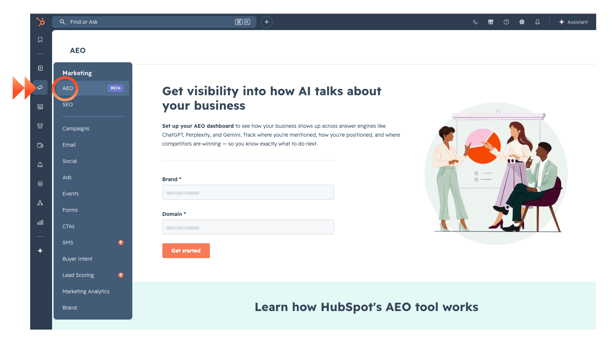
What this solves is a visibility problem. Right now, most B2B marketing teams are optimizing for channels they can measure and ignoring a channel they can't see. AEO monitoring closes that gap. You get a clear picture of where your brand appears, where it doesn't, and – critically – what competitors are being cited in your place.
The business impact is straightforward: you can't pursue a buyer who doesn't know you exist. If a procurement manager asks an AI to shortlist three suppliers for a category you operate in and your name doesn't appear, that opportunity is gone before it reaches your pipeline.
Setup guidance is available directly in HubSpot's documentation. It takes less than an afternoon to configure.
Quick Win 2: Audit Your Highest-Traffic Pages for Answer Readiness
AEO monitoring will quickly surface a pattern: pages that are good at ranking are often poor at answering. They're optimized for keywords, not for the way a buyer phrases a question to an AI assistant.
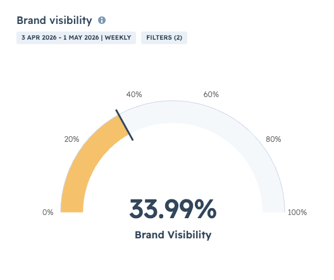
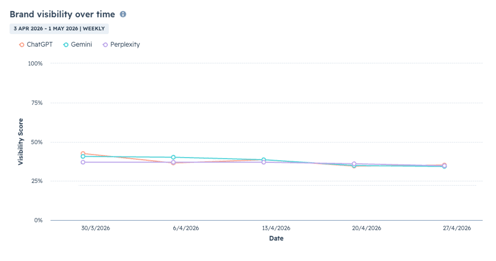
The fix is not a content overhaul. It's a targeted audit of your five to ten highest-traffic pages, evaluated against a simple standard: does this page clearly answer a specific question that a buyer at this stage of the decision process would ask?
Pages that perform well in AI citations tend to share a few characteristics.
1. They open with a direct, substantive answer rather than context-setting.
2. They use structured, scannable formatting.
3. They include concrete specifics, like lead times, technical specifications, process descriptions, or comparison data , rather than general statements about quality and service.
Quick Win 3: Build Structured FAQ Content Around Real Buyer Questions
One of the most reliable ways to increase AI citation is to publish content that directly answers the questions your sales team hears most often. This is all about specific, practical answers to the questions that come up in every first or second sales conversation.
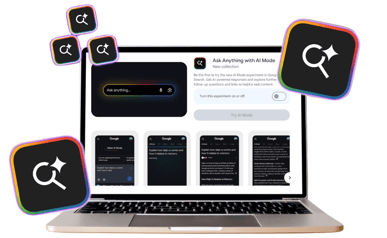
HubSpot's content tools make it straightforward to publish this kind of page, whether as a standalone FAQ, a resource section on a product page, or a structured blog article. The key is that the questions should be drawn from real data: your sales call notes, your HubSpot conversation history, your support tickets.
Quick Win 4: Connect Your Content Performance to Pipeline Data
The final quick win is less about content creation and more about measurement discipline. HubSpot allows you to connect content attribution to deal activity, meaning you can see, at a contact and deal level, which pages a buyer visited before they converted.
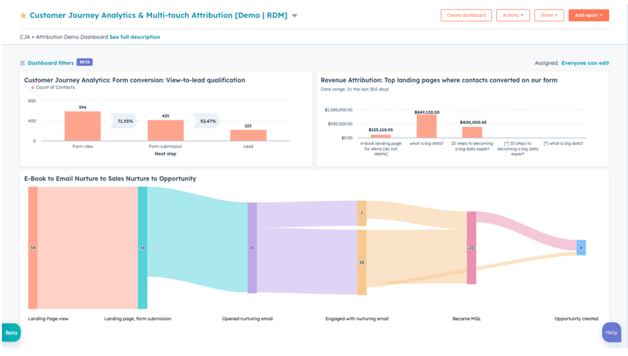
Most teams don't have this configured properly, which means they're making content decisions based on traffic and rankings alone, without understanding which content actually precedes revenue. When AEO monitoring is layered on top of proper attribution tracking, the picture becomes significantly more useful. You can not only see which pages are getting traffic from AI-referred visitors, but whether those visitors are converting and at what rate.
The Takeaway
The shift to AI-assisted research is not a future trend to monitor. It is already how your buyers behave. The companies that show up credibly in AI-generated answers over the next twelve months will have a meaningful and compounding advantage over those that don't.
The barrier to acting on this is not technical complexity. HubSpot has already built the monitoring and content tools required. The barrier is operational inertia – the tendency to keep optimizing the channels you've always measured while a new one grows unattended.
Four weeks of focused effort on the quick wins above – activating AEO tracking, auditing your key pages, publishing structured answers to real buyer questions, and connecting content to pipeline data – will put your business in a stronger position than the majority of competitors in your category.
The configuration is already in your HubSpot account. Success now depends on whether your team is using it.
Fileroom helps B2B and industrial businesses get more out of their HubSpot investment. If you'd like to understand how your current setup measures up on AEO readiness, we're happy to take a look.




.png)




-1.png?width=19&height=19&name=Vector%20(3)-1.png)

.png?width=19&height=16&name=Vector%20(4).png)

.png?width=18&height=24&name=Vector%20(5).png)